JEE Main General Organic Chemistry (GOC) PYQs 2024, 2025 and 2026: All Questions with Solutions
By CompetishunNov 18, 202640 min read
JEE Main General Organic Chemistry (GOC) PYQs 2024, 2025 and 2026: All Questions with Solutions
Verified JEE Main GOC questions from 2024, 2025 and 2026, shift by shift. The 2024, 2025 and 2026 sets are interactive now: pick an option or enter a number and check instantly. Attempt timed, check the method only after answering, and log every miss by pattern.
Score: 0 correct out of 0 attempted ( interactive questions)
How to use this quiz
1. Attempt one year timed, without looking at the method.
2. Click an option, or type a number and press Check, for instant right or wrong feedback.
3. Read the short method only after answering, then log the miss by pattern.
4. Rework your weak patterns the same day, then reattempt the year.
2024 Questions (39)
Q127 Jan 2024, Shift 1
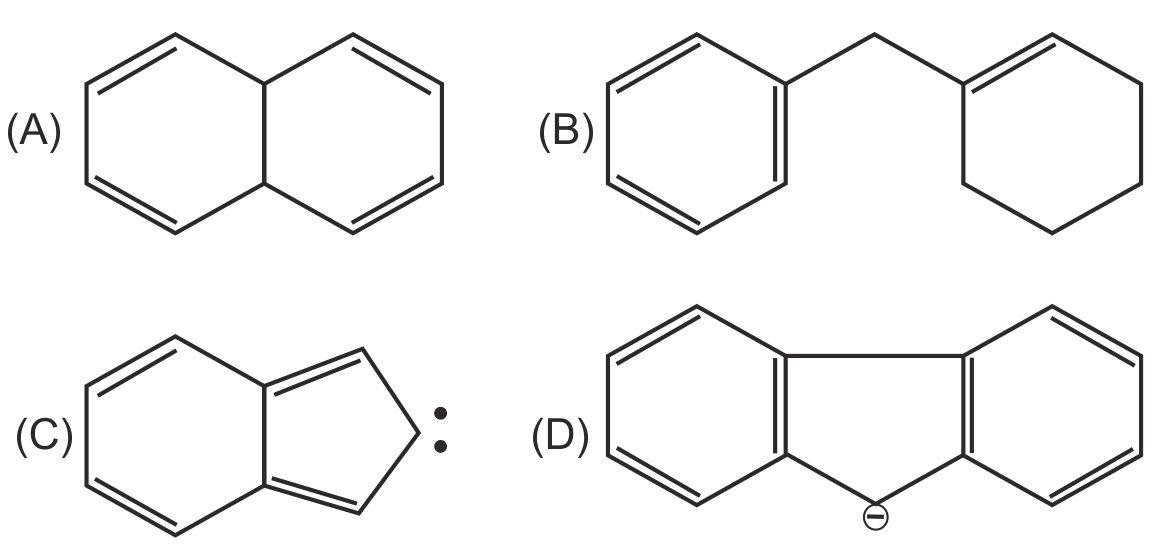
Among the given organic compounds, the total number of aromatic compounds is The four compounds are: (A) 1,4,5,8-tetrahydronaphthalene (two fused six-membered rings, each a 1,3-diene, with sp3 bridgehead carbons); (B) benzyl-cyclohexene (a benzene ring joined by a CH2 group to a cyclohexene ring); (C) an indenylidene carbene (a benzene ring fused to a five-membered ring carrying a carbene carbon); (D) the fluorenyl anion (two benzene rings joined through a five-membered ring bearing a negative charge).
Answer: 3. Method: B, C and D are aromatic: the benzene ring in (B); the five-membered ring in (C), whose carbene lone pair completes a 6 pi electron system; and the fluorenyl anion (D), a 14 pi electron system. (A) is not aromatic: its bridgehead carbons are sp3, so neither ring is a cyclic conjugated 6 pi system. So there are 3 aromatic compounds.
Q227 Jan 2024, Shift 1
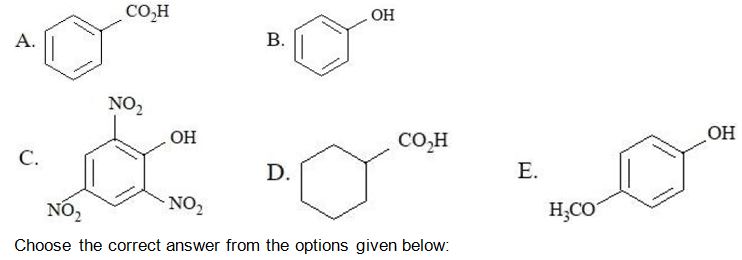
The ascending order of acidity of -OH group in the following compounds is : Choose the correct answer from the options given below : The five compounds are: (A) butan-1-ol (Bu-OH); (B) 4-nitrophenol; (C) 4-methoxyphenol; (D) phenol; (E) 2,4-dinitrophenol.
Correct option: D. Method: Acidity increases as pKa falls: butan-1-ol (A, pKa about 16) is the least acidic, then 4-methoxyphenol (C, pKa about 10.2), phenol (D, pKa 10.0), 4-nitrophenol (B, pKa 7.1) and 2,4-dinitrophenol (E, pKa about 4.1), the most acidic. So the ascending order of acidity is (A) < (C) < (D) < (B) < (E).
Q327 Jan 2024, Shift 1
Choose the polar molecule from the following :
Correct option: D. Method: CCl4, CO2 and ethene are all symmetrical and non-polar. CHCl3 has three polar C-Cl bonds whose dipoles do not cancel, so it is polar. So the polar molecule is CHCl3.
Q427 Jan 2024, Shift 1
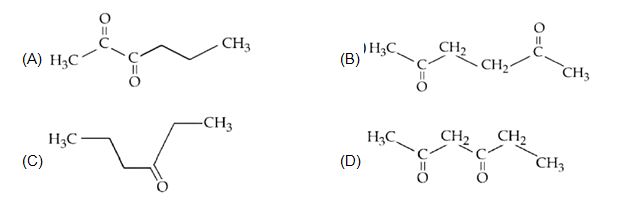
Which of the following has highly acidic hydrogen? The four compounds are: (A) hexane-2,3-dione; (B) hexane-2,5-dione; (C) hexan-3-one; (D) hexane-2,4-dione. (A) = A, (B) = B, (C) = C, (D) = D.
Correct option: D. Method: Hexane-2,4-dione (D) is a beta-diketone: its central CH2 group is flanked by two carbonyl groups, so its hydrogen is the most acidic (the enolate is stabilised by two carbonyl groups). In (A) and (B) the CH2 groups are next to only one carbonyl group, and (C) is a simple ketone. So (D) has the most highly acidic hydrogen.
Q527 Jan 2024, Shift 1
Which of the following is strongest Bronsted base The four bases are: (A) aniline; (B) diphenylamine; (C) pyrrole; (D) pyrrolidine. (A) = A, (B) = B, (C) = C, (D) = D.
Correct option: D. Method: Pyrrolidine (D) is the strongest base: a saturated secondary amine whose nitrogen lone pair is localised on an sp3 nitrogen. In aniline (A) and diphenylamine (B) the lone pair is delocalised into the benzene ring(s), and in pyrrole (C) the lone pair is part of the aromatic sextet, so it is barely basic. So (D) is the strongest Bronsted base.
Q627 Jan 2024, Shift 1
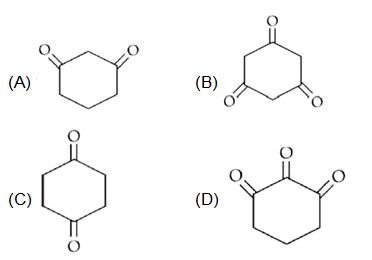
Highest enol content will be shown by : The four compounds are: (A) cyclohexane-1,3-dione; (B) cyclohexane-1,3,5-trione; (C) cyclohexane-1,4-dione; (D) cyclohexane-1,2,3-trione. (A) = A, (B) = B, (C) = C, (D) = D.
Correct option: B. Method: Cyclohexane-1,3,5-trione (B) shows the highest enol content: its fully enolised form is phloroglucinol (benzene-1,3,5-triol), which is aromatic, so enolisation is strongly favoured. The 1,3-diketone (A) also enolises well, but its enol is not aromatic. The 1,4-diketone (C) and the 1,2,3-triketone (D) show much less enol content. So (B) has the highest enol content.
Q727 Jan 2024, Shift 2
The technique used for purification of steam volatile water immiscible substance is:
Correct option: D. Method: Steam distillation is used for liquids that are steam volatile, immiscible with water and contain non-volatile impurities.
Q827 Jan 2024, Shift 2
The order of relative stability of the contributing structure is: Choose the correct answer from the options given below: The three contributing structures of acrolein are: (I) CH2=CH-CH=O (neutral); (II) CH2=CH-C+(H)-O− (positive charge on carbon, negative charge on oxygen); (III) -CH2-CH=C(H)-O+ (negative charge on the terminal carbon, positive charge on oxygen).
Correct option: A. Method: Neutral structures are more stable than charged ones, so (I) is the most stable. Between (II) and (III), a positive charge on the less electronegative carbon (II) is more stable than a positive charge on oxygen (III), so (II) is more stable than (III). So the order is I > II > III.
Q929 Jan 2024, Shift 1
The interaction between π bond and lone pair of electrons present on an adjacent atom is responsible for
Correct option: D. Method: The interaction between a pi bond and a lone pair on an adjacent atom gives delocalisation of the lone pair into the pi system, which is the resonance effect.
Q1029 Jan 2024, Shift 1
Appearance of blood red colour, on treatment of the sodium fusion extract of an organic compound with FeSO4 in presence of concentrated H2SO4 indicates the presence of element/s
Correct option: C. Method: A blood red colour with FeSO4 in concentrated H2SO4 (the sodium fusion extract test) comes from ferric thiocyanate, Fe(SCN)3, which forms only when both nitrogen and sulphur are present. So the elements are N and S.
Q1129 Jan 2024, Shift 1
The difference in energy between the actual structure and the lowest energy resonance structure for the given compound is
Correct option: B. Method: The difference in energy between the actual structure and the lowest energy resonance structure is the resonance energy.
Q1229 Jan 2024, Shift 2
Match List I with List II Choose the correct answer from the options given below : List-I (Compound): (A) Ethanol; (B) Phenol; (C) m-Nitrophenol; (D) p-Nitrophenol. List-II (pKa value): (I) 10.0; (II) 15.9; (III) 7.1; (IV) 8.3.
Correct option: D. Method: Ethanol (A) has pKa 15.9 (II); phenol (B) has pKa 10.0 (I); m-nitrophenol (C) has pKa 8.3 (IV); p-nitrophenol (D) has pKa 7.1 (III). So A-II, B-I, C-IV, D-III.
Q1329 Jan 2024, Shift 2
The ascending acidity order of the following H atoms is The four hydrogens are: (A) the acetylenic hydrogen, HC≡C-H; (B) the vinylic hydrogen, H2C=CH-H; (C) the tert-butyl hydrogen, (CH3)3C-H; (D) the ethyl hydrogen, CH3-CH2-H.
Correct option: A. Method: Acidity falls as the s-character of the carbon falls: the acetylenic C-H (A, sp, pKa about 25) is the most acidic, then the vinylic C-H (B, sp2, pKa about 44), then the primary alkyl C-H (D, sp3, pKa about 50), then the tertiary alkyl C-H (C, sp3, pKa about 53). So the ascending order of acidity is C < D < B < A.
Q1430 Jan 2024, Shift 1
On a thin layer chromatographic plate, an organic compound moved by 3.5 cm , while the solvent moved by 5 cm . The retardation factor of the organic compound is ____ × 10−1
Answer: 7. Method: The retardation factor Rf is the distance moved by the compound divided by the distance moved by the solvent: 3.5 / 5 = 0.7, which is 7 × 10⁻¹. So the answer is 7.
Q1530 Jan 2024, Shift 1
Which of the following molecule/species is most stable? The four species are: (1) the cyclopropenyl cation (a three-membered ring with one double bond and a positive charge); (2) the cyclopentadienyl cation (a five-membered ring with two double bonds and a positive charge); (3) the cyclopropenyl anion (a three-membered ring with one double bond and a lone pair on the saturated carbon); (4) cyclohexa-1,3-diene. (1) = A, (2) = B, (3) = C, (4) = D.
Correct option: A. Method: The cyclopropenyl cation (1) is aromatic (2 pi electrons) and the most stable. The cyclopentadienyl cation (2) is antiaromatic (4 pi electrons), the cyclopropenyl anion (3) is antiaromatic (4 pi electrons) and cyclohexa-1,3-diene (4) is non-aromatic. So the most stable species is (1).
Q1630 Jan 2024, Shift 2
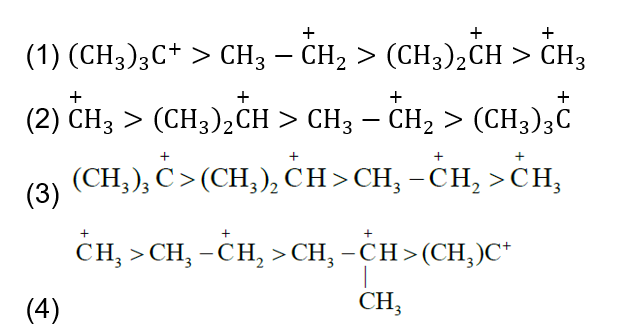
The correct stability order of carbocations is The four orders are: (1) (CH3)3C+ > CH3-CH2+ > (CH3)2CH+ > CH3+; (2) CH3+ > (CH3)2CH+ > CH3-CH2+ > (CH3)3C+; (3) (CH3)3C+ > (CH3)2CH+ > CH3-CH2+ > CH3+; (4) CH3+ > CH3-CH2+ > CH3-CH+(CH3) > (CH3)3C+. (1) = A, (2) = B, (3) = C, (4) = D.
Correct option: C. Method: Carbocation stability rises with the number of alkyl groups (hyperconjugation and inductive effect): tertiary > secondary > primary > methyl. So the correct order is (CH3)3C+ > (CH3)2CH+ > CH3-CH2+ > CH3+, which is (3).
Q1731 Jan 2024, Shift 1
Match List I with List II Choose the correct answer from the options given below: List-I (Technique): (A) Distillation; (B) Fractional distillation; (C) Steam distillation; (D) Distillation under reduced pressure. List-II (Application): (I) Separation of glycerol from spent-lye; (II) Aniline-Water mixture; (III) Separation of crude oil fractions; (IV) Chloroform-Aniline.
Correct option: B. Method: Distillation (A) separates the chloroform-aniline mixture (IV); fractional distillation (B) separates crude oil fractions (III); steam distillation (C) separates the aniline-water mixture (II); distillation under reduced pressure (D) separates glycerol from spent lye (I). So A-IV, B-III, C-II, D-I.
Q1831 Jan 2024, Shift 1
Given below are two statements: One is labelled as Assertion A and the other is labelled as Reason R: Assertion A: pKa value of phenol is 10.0 while that of ethanol is 15.9 . Reason R: Ethanol is stronger acid than phenol. In the light of the above statements, choose the correct answer from the options given below:
Correct option: A. Method: Assertion A is true: the pKa of phenol is 10.0 and of ethanol is 15.9. Reason R is false: ethanol is a weaker acid than phenol (phenol is the stronger acid, since the phenoxide ion is resonance-stabilised). So A is true but R is false.
Q1931 Jan 2024, Shift 1
'Adsorption' principle is used for which of the following purification method?
Correct option: B. Method: Chromatography separates compounds by differential adsorption on the stationary phase, so the adsorption principle is used in chromatography.
Q2031 Jan 2024, Shift 2
The fragrance of flowers is due to the presence of some steam volatile organic compounds called essential oils. These are generally insoluble in water at room temperature but are miscible with water vapour in vapour phase. A suitable method for the extraction of these oils from the flowers is
Correct option: D. Method: Essential oils are steam volatile and immiscible with water, so steam distillation is the suitable method for extracting them from flowers.
Q2131 Jan 2024, Shift 2
A species having carbon with sextet of electrons and can act as electrophile is called
Correct option: C. Method: A species with a carbon carrying only six electrons (a sextet) that can act as an electrophile is a carbocation.
Q221 Feb 2024, Shift 1
Total number of deactivating groups in aromatic electrophilic substitution reaction among the following is The five groups are: -COOCH3 (methoxycarbonyl); -NHCOCH3 (acetamido); -NHCH3 (methylamino); -C≡N (cyano); -OCH3 (methoxy).
Answer: 2. Method: Deactivating groups for aromatic electrophilic substitution are -COOCH3 (ester, electron-withdrawing by resonance) and -C≡N (cyano, electron-withdrawing by resonance). -NHCOCH3, -NHCH3 and -OCH3 are all activating (their nitrogen or oxygen lone pair donates by resonance). So there are 2 deactivating groups.
Q231 Feb 2024, Shift 1
In Kjeldahl's method for estimation of nitrogen, CuSO4 acts as :
Correct option: B. Method: In Kjeldahl's method, CuSO4 acts as a catalyst in the digestion of the organic compound with concentrated sulphuric acid. So it acts as a catalytic agent.
Q241 Feb 2024, Shift 1
Ionic reactions with organic compounds proceed through: (A) Homolytic bond cleavage (B) Heterolytic bond cleavage (C) Free radical formation (D) Primary free radical (E) Secondary free radical Choose the correct answer from the options given below:
Correct option: C. Method: Ionic reactions proceed through heterolytic bond cleavage, which forms ions, so only (B) is correct.
Q251 Feb 2024, Shift 1
Which of the following compound will most easily be attacked by an electrophile? The four compounds are: (1) benzene; (2) toluene; (3) chlorobenzene; (4) phenol. (1) = A, (2) = B, (3) = C, (4) = D.
Correct option: D. Method: Phenol (4) is attacked most easily by an electrophile: the OH group donates electrons by resonance, giving the ring the highest electron density of the four. Toluene (2) is activated by the methyl group, benzene (1) is unsubstituted and chlorobenzene (3) is deactivated. So (4) is attacked most easily.
Q261 Feb 2024, Shift 2
The functional group that shows negative resonance effect is:
Correct option: C. Method: The functional group that shows a negative resonance effect is -COOH: it withdraws electrons by resonance (-R). -NH2, -OH and -OR all show a positive resonance effect (+R). So the answer is -COOH.
Q271 Feb 2024, Shift 2
The set of meta directing functional groups from the following sets is:
Correct option: C. Method: The meta-directing groups are -NO2, -CHO, -SO3H and -COR (all electron-withdrawing by resonance). The other sets contain -NH2, -NHR, -OCH3 or -NHCOCH3, which are ortho-para directing. So the set of meta-directing groups is -NO2, -CHO, -SO3H, -COR.
Q284 Apr 2024, Shift 1
How many compounds among the following compounds show inductive, mesomeric as well as hyperconjugation effects? The eight compounds are: anisole; 4-methylpent-3-en-2-one (mesityl oxide); benzene; chlorocyclohexane; 1-isopropyl-2-nitrobenzene; 2-nitrostyrene; 1,3-dimethylbenzene (m-xylene); 1-acetyl-2-methylcyclohex-1-ene.
Answer: 4. Method: Four compounds show all three effects: anisole (inductive and mesomeric effects of OCH3, hyperconjugation of the methyl group); 4-methylpent-3-en-2-one (conjugated enone with methyl groups); 1-isopropyl-2-nitrobenzene (nitro group mesomeric and inductive, isopropyl hyperconjugation); and 1-acetyl-2-methylcyclohex-1-ene (conjugated enone with methyl groups). Benzene has no substituent, chlorocyclohexane has no conjugation, 2-nitrostyrene has no alkyl group for hyperconjugation and m-xylene has no mesomeric effect. So the answer is 4.
Q294 Apr 2024, Shift 1
Relative stability of the contributing structures is : The three contributing structures of the enol are: (I) CH3-CH=C(H)-O with two lone pairs on oxygen (neutral); (II) CH3-CH=C(H)-O− with a negative charge on oxygen; (III) -CH2-CH=C(H)-O+ with a negative charge on the terminal carbon and a positive charge on oxygen.
Correct option: B. Method: Neutral structures are more stable than charged ones, so (I) is the most stable. Between (II) and (III), a positive charge on the less electronegative carbon (II) is more stable than a positive charge on oxygen (III), so (II) is more stable than (III). So the order is (I) > (II) > (III).
Q304 Apr 2024, Shift 1
Methods used for purification of organic compounds are based on :
Correct option: C. Method: Methods of purification are chosen according to the nature of the compound and the impurity present in it.
Q315 Apr 2024, Shift 1
For the compounds : (A) H3C-CH2-O-CH2-CH2-CH3 (B) H3C-CH2-CH2-CH2-CH3 (C) (D) The increasing order of boiling point is : Choose the correct answer from the options given below : The four compounds are: (A) ethyl propyl ether, CH3-CH2-O-CH2-CH2-CH3; (B) n-pentane, CH3-CH2-CH2-CH2-CH3; (C) pentan-3-one, CH3-CH2-CO-CH2-CH3; (D) pentan-2-ol, CH3-CH(OH)-CH2-CH2-CH3.
Correct option: B. Method: For compounds with the same number of carbon atoms, boiling point follows: hydrogen bonding > high polarity > low polarity > non-polar. (D) is an alcohol (hydrogen bonding), (C) is a ketone (polar), (A) is an ether (low polarity) and (B) is an alkane (non-polar). So the increasing order is (B) < (A) < (C) < (D).
Q326 Apr 2024, Shift 1
Number of molecules from the following which can exhibit hydrogen bonding is . (nearest integer) The molecules are: methanol (CH3OH); water (H2O); ethane (C2H6); benzene (C6H6); 2-nitrophenol; hydrogen fluoride (HF); ammonia (NH3).
Answer: 5. Method: Hydrogen bonding is shown by methanol, water, 2-nitrophenol (intramolecular hydrogen bonding), hydrogen fluoride and ammonia: 5 molecules. Ethane and benzene cannot form hydrogen bonds. So the answer is 5.
Q336 Apr 2024, Shift 1
Which of the following statements are correct ? A. Glycerol is purified by vacuum distillation because it decomposes at its normal boiling point. B. Aniline can be purified by steam distillation as aniline is miscible in water. C. Ethanol can be separated from ethanol water mixture by azeotropic distillation because it forms azeotrope. D. An organic compound is pure, if mixed M.P. is remained same. Choose the most appropriate answer from the options given below :
Correct option: B. Method: A is correct (glycerol decomposes at its normal boiling point, so it is purified by vacuum distillation); B is incorrect (aniline is immiscible in water, not miscible); C is correct (ethanol forms an azeotrope with water, so azeotropic distillation separates it); D is correct (a pure organic compound keeps the same mixed melting point). So the correct statements are A, C and D only.
Q348 Apr 2024, Shift 1
Which of the following are aromatic? The four compounds are: (A) 1,4,5,8-tetrahydronaphthalene (two fused six-membered rings, each a 1,3-diene, with sp3 bridgehead carbons); (B) styrene (a benzene ring with a vinyl group); (C) cyclodecapentaene ([10]annulene, a ten-membered ring with five double bonds); (D) cyclooctadecanonaene ([18]annulene, an eighteen-membered ring with nine double bonds).
Correct option: A. Method: Styrene (B) is aromatic (its benzene ring) and [18]annulene (D) is aromatic (18 pi electrons, planar). 1,4,5,8-Tetrahydronaphthalene (A) is not aromatic (its bridgehead carbons are sp3, so the rings are isolated dienes), and [10]annulene (C) is not aromatic (it is non-planar because of crowding of the inner hydrogens). So the aromatic compounds are B and D only.
Q359 Apr 2024, Shift 1
Which of the following nitrogen containing compound does not give Lassaigne's test ?
Correct option: D. Method: Lassaigne's test detects nitrogen only when the compound also contains carbon (the test forms NaCN). Hydrazine (NH2-NH2) contains no carbon, so it does not give Lassaigne's test. Phenyl hydrazine, glycine and urea all contain carbon and give the test. So the answer is hydrazine.
Q369 Apr 2024, Shift 1
Which among the following is incorrect statement ?
Correct option: D. Method: The electromeric effect dominates over the inductive effect (A is correct); it is a temporary effect (B is correct); it operates only in the presence of a reagent (C is correct). A hydrogen ion shows a positive electromeric effect (+E), not a negative one, so statement D is incorrect. So the incorrect statement is D.
Q379 Apr 2024, Shift 1
What will be the decreasing order of basic strength of the following conjugate bases? -OH, RO, CH3COO, Cl
Correct option: B. Method: A strong acid has a weak conjugate base. Acid strength is HCl > CH3COOH > H2O > R-OH, so conjugate base strength is the reverse: RO− > OH− > CH3COO− > Cl−. So the decreasing order is RO− > -OH > CH3COO− > Cl−.
Q389 Apr 2024, Shift 1
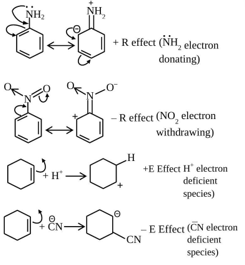
Match List -I with List II : The four rows show: aniline, where the NH2 group donates electrons (+R effect, electron donating); nitrobenzene, where the NO2 group withdraws electrons (-R effect, electron withdrawing); benzene with H+, an electron-deficient species (+E effect); and benzene with CN−, an electron-deficient species (-E effect).
Correct option: A. Method: Matching the effects: (A) +R effect is the NH2 group donating electrons (IV); (B) -R effect is the NO2 group withdrawing electrons (III); (C) +E effect is H+, an electron-deficient species (I); (D) -E effect is CN−, an electron-deficient species (II). So (A)-(IV), (B)-(III), (C)-(I), (D)-(II).
Q399 Apr 2024, Shift 2
Correct order of basic strength of Pyrrole The three compounds are: pyrrole (a five-membered ring with NH); pyridine (a six-membered ring with N); piperidine (a saturated six-membered ring with NH).
Correct option: A. Method: Piperidine is the strongest base (its nitrogen lone pair is localised on an sp3 nitrogen). Pyridine is next (its lone pair is localised on an sp2 nitrogen but not part of the aromatic sextet). Pyrrole is the weakest base (its lone pair is part of the aromatic sextet). So the order is Piperidine > Pyridine > Pyrrole.
The most stable carbocation from the following is : The four carbocations are: (1) the 4-methoxybenzyl cation (p-MeO-C6H4-CH2+); (2) the benzyl cation (C6H5-CH2+); (3) the 3-methoxybenzyl cation (m-MeO-C6H4-CH2+); (4) the 4-methylbenzyl cation (p-CH3-C6H4-CH2+). (1) = A, (2) = B, (3) = C, (4) = D.
Correct option: A. Method: The 4-methoxybenzyl cation (1) is the most stable: the para methoxy group donates its lone pair by resonance directly into the benzylic cation. The meta methoxy group in (3) cannot donate by resonance, and the methyl group in (4) stabilises only by hyperconjugation. So (1) is the most stable.
Q223 Jan 2025, Shift 1
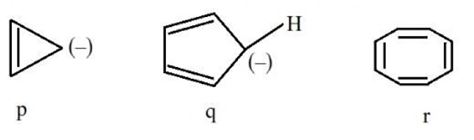
The correct stability order of the following species/molecules is: The three species are: (p) the cyclopropenyl anion (a three-membered ring with one double bond and a negative charge); (q) the cyclopentadienyl anion (a five-membered ring with two double bonds and a negative charge on the saturated carbon); (r) cyclohexa-1,3-diene (a six-membered ring with two double bonds).
Correct option: C. Method: q is aromatic (6 pi electrons, planar, cyclic conjugation), r is non-aromatic (a conjugated diene, but the ring is not fully unsaturated, so there is no cyclic conjugation), and p is antiaromatic (4 pi electrons in a cyclic conjugated system). Aromatic is more stable than non-aromatic, which is more stable than antiaromatic, so the order is q > r > p.
Q324 Jan 2025, Shift 1
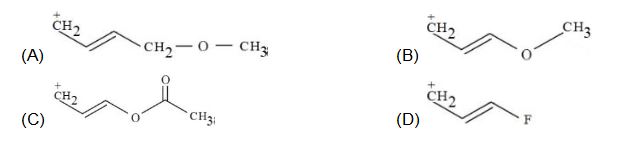
Which one of the carbocations from the following is most stable? The four carbocations are: (A) +CH2-CH=CH-CH2-O-CH3; (B) +CH2-CH=CH-O-CH3; (C) +CH2-CH=CH-O-CO-CH3; (D) +CH2-CH=CH-F. (A) = A, (B) = B, (C) = C, (D) = D.
Correct option: B. Method: In (B) the methoxy oxygen is directly conjugated with the allylic cation, and its lone pair donates strongly by resonance (+M), so (B) is the most stable. In (A) the oxygen is separated from the cation by a CH2 group, so it cannot donate by resonance. In (C) the oxygen is attached to an electron-withdrawing carbonyl group, and in (D) fluorine donates less effectively than a methoxy group. So (B) is the most stable.
Q428 Jan 2025, Shift 1
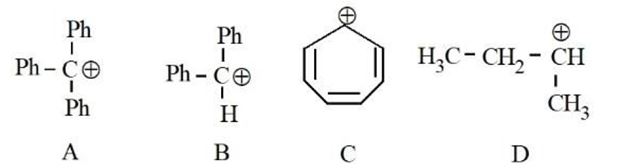
The correct order of stability of following carbocations is : The four carbocations are: (A) the triphenylmethyl (trityl) cation, Ph3C+; (B) the diphenylmethyl cation, Ph2CH+; (C) the tropylium cation (a seven-membered ring with three double bonds and a positive charge); (D) the sec-butyl cation, CH3-CH2-CH+(CH3).
Correct option: C. Method: The tropylium cation (C) is aromatic (6 pi electrons) and the most stable. The trityl cation (A) is stabilised by three phenyl rings, the diphenylmethyl cation (B) by two, and the sec-butyl cation (D) only by hyperconjugation. So the order is C > A > B > D.
Q528 Jan 2025, Shift 1
The compounds that produce CO2 with aqueous NaHCO3 solution are: The five compounds are: (A) benzoic acid; (B) phenol; (C) picric acid (2,4,6-trinitrophenol); (D) cyclohexanecarboxylic acid; (E) 4-methoxyphenol.
Correct option: D. Method: Only acids stronger than carbonic acid give CO2 with aqueous NaHCO3. Benzoic acid (A), picric acid (C) and cyclohexanecarboxylic acid (D) are carboxylic acids or a very strong phenol, all stronger than carbonic acid. Phenol (B) and 4-methoxyphenol (E) are weaker than carbonic acid and do not give CO2. So A, C and D only.
Q62 Apr 2025, Shift 1
The correct order of basic nature in aqueous solution for the bases NH3,H2N - NH2,CH3CH2NH2,( CH3CH2 )2NH and ( CH3CH2 )3N is :
Correct option: D. Method: In aqueous solution the basicity order is: hydrazine (H2N-NH2) is the weakest (the adjacent nitrogen withdraws electrons), then ammonia, then ethylamine, then triethylamine, then diethylamine (the strongest, the best balance of inductive effect and solvation). So the order is H2N-NH2 < NH3 < CH3CH2NH2 < (CH3CH2)3N < (CH3CH2)2NH.
Q72 Apr 2025, Shift 1
Consider the following compound (X) The most stable and least stable carbon radicals, respectively, produced by homolytic cleavage of corresponding C - H bond are : Compound (X) is 4-methylpent-1-yne, H-C≡C-CH2-CH(CH3)-CH3. The labelled C-H bonds are: (I) the acetylenic C-H; (II) the propargylic CH2; (III) the methine C-H; (IV) the methyl C-H.
Correct option: A. Method: Homolytic cleavage at (II) gives a propargylic radical, resonance-stabilised by the triple bond, so it is the most stable. Cleavage at (I) gives an acetylenic radical on an sp carbon with no resonance stabilisation, so it is the least stable. The most stable and least stable radicals are II and I respectively.
Q83 Apr 2025, Shift 1
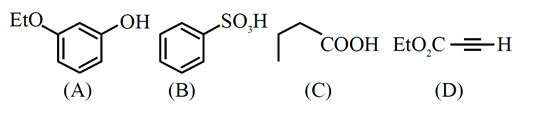
The least acidic compound, among the following is: The four compounds are: (A) 4-ethoxyphenol; (B) benzenesulfonic acid; (C) butanoic acid; (D) ethyl propiolate (EtO2C-C≡CH).
Correct option: A. Method: The least acidic compound is the terminal alkyne (D): its acetylenic hydrogen is far less acidic than a phenol, a carboxylic acid or a sulfonic acid. Benzenesulfonic acid (B) is the strongest acid of the four, followed by butanoic acid (C) and 4-ethoxyphenol (A). So the least acidic is (D).
Q93 Apr 2025, Shift 2
Given below are two statements: Statement I : Hyperconjugation is not a permanent effect. Statement II : In general, greater the number of alkyl groups attached to a positively charged Cation, greater is the hyperconjugation interaction and stabilization of the cation. In the light of the above statements, choose the correct answer from the options given below
Correct option: B. Method: Statement I is false: hyperconjugation is a permanent effect, it needs no external reagent. Statement II is true: more alkyl groups on a positively charged carbon mean more alpha-hydrogens, more hyperconjugation and more stabilisation of the cation. Statement I is false but Statement II is true.
Q104 Apr 2025, Shift 1
Given below are two statements. Statement I: The dipole moment of CH34 - CH3 = CH2 - CH1 = O is greater than CH34 - CH23 - CH22 - CH1 = O Statement II: C1 - C2 bond length of CH34 - CH3 = CH2 - CH1 = O is greater than C1 - C2 bond length of CH34 - CH23 - CH22 - CH1 = O In the light of the above statements, choose the correct answer from the options given below
Correct option: A. Method: Statement I is true: but-3-enal (CH3-CH=CH-CHO) is conjugated, and conjugation increases the dipole moment compared with butanal (CH3-CH2-CH2-CHO). Statement II is false: the C1−C2 bond in the conjugated enal has partial double-bond character, so it is shorter than the C1−C2 single bond in butanal, not longer. Statement I is true but Statement II is false.
Q114 Apr 2025, Shift 2
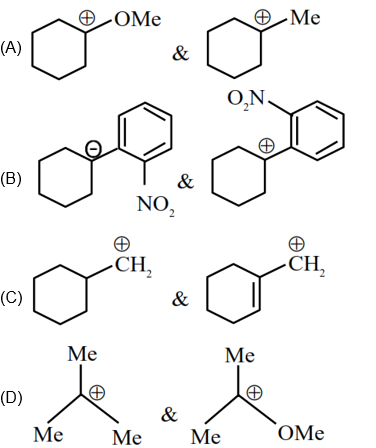
In which pairs, the first ion is more stable than the second? The four pairs are: (A) the 1-methoxycyclohexyl cation and the 1-methylcyclohexyl cation; (B) the 1−(2-nitrophenyl)cyclohexyl anion and the 1−(2-nitrophenyl)cyclohexyl cation; (C) the cyclohexylmethyl cation and the cyclohex-2-en-1-ylmethyl cation; (D) the tert-butyl cation and the 2-methoxypropan-2-yl cation.
Correct option: A. Method: In (A) the methoxy group stabilises the cation by resonance (+M), so the first ion is more stable than the 1-methylcyclohexyl cation. In (B) the nitro group stabilises the anion and destabilises the cation, so the first ion is more stable. In (C) the second ion is an allylic cation, resonance-stabilised, so the first ion is less stable. In (D) the second ion is stabilised by the methoxy group, so the first ion is less stable. The first ion is more stable in (A) and (B) only.
Q124 Apr 2025, Shift 2
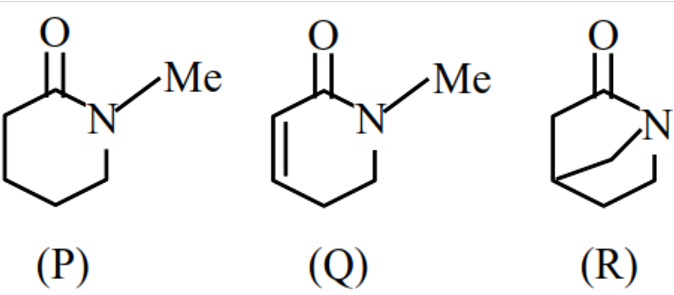
The correct order of basicity for the following molecules is : The three lactams are: (P) 1-methylpiperidin-2-one (a saturated lactam); (Q) 1-methyl-5,6-dihydro-pyridin-2(1H)-one (an alpha,beta-unsaturated lactam); (R) a bridged bicyclic lactam (a twisted amide, the nitrogen lone pair cannot overlap with the carbonyl group).
Correct option: B. Method: In (R) the bridged structure twists the amide out of planarity, so the nitrogen lone pair cannot delocalise into the carbonyl group and (R) behaves like an ordinary amine, the most basic. In (Q) the carbon-carbon double bond is conjugated with the carbonyl group, raising the electron density at the carbonyl oxygen compared with the saturated lactam (P). So the order is R > Q > P.
Q138 Apr 2025, Shift 2
Match the LIST-I with LIST-II Choose the correct answer from the options given below: List-I (Species): (A) Carbocation; (B) Carbon free radical; (C) Nucleophile; (D) Electrophile. List-II (Description): (I) Species that can supply a pair of electrons; (II) Species that can receive a pair of electrons; (III) sp2 hybridised carbon with empty p-orbital; (IV) sp2/sp3 hybridised carbon with one unpaired electron.
Correct option: B. Method: A carbocation is an sp2 carbon with an empty p-orbital (III); a carbon free radical is an sp2/sp3 carbon with one unpaired electron (IV); a nucleophile supplies a pair of electrons (I); an electrophile receives a pair of electrons (II). So A-III, B-IV, C-I, D-II.
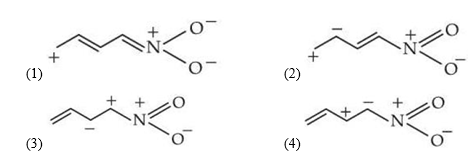
From the following, the least stable structure is : The four resonance structures are: (1) the positive charge on the terminal carbon of the conjugated diene, with the nitro group as N+(O−)2; (2) the positive charge on the terminal carbon and a negative charge on the next carbon, with the nitro group as N+(=O)(O−); (3) a negative charge on the carbon next to the double bond and a positive charge on the carbon next to the nitro nitrogen, so two positive charges sit on adjacent atoms; (4) a positive charge on the carbon next to the double bond (allylic) and a negative charge on the carbon next to the nitro nitrogen. (1) = A, (2) = B, (3) = C, (4) = D.
Correct option: C. Method: (3) is the least stable: it puts a positive charge on the carbon directly attached to the positively charged nitro nitrogen, so two positive charges sit on adjacent atoms, and its charges are not delocalised by the diene. In (4) the positive charge is on the allylic carbon (resonance-stabilised) and the negative charge sits next to the nitro nitrogen. In (1) and (2) the positive charge is at the end of the conjugated diene. So (3) is the least stable.
Q223 Jan 2026, Shift 2
Given below are two statements: Statement I: (CH3)3 C⊕ is more stable than C⊕H3 as nine hyperconjugation interactions are possible in (CH3)3 C⊕. Statement II: C⊕H3 is less stable than (CH3)3 C⊕ as only three hyperconjugation interactions are possible in C⊕H3. In the light of the above statements, choose the correct answer from the options given below
Correct option: A. Method: Statement I is true: the tert-butyl cation has nine hyperconjugable alpha-hydrogens (three methyl groups), so it is more stable than the methyl cation. Statement II is false: the methyl cation has no alpha-hydrogen at all, so zero hyperconjugation interactions are possible in it, not three. Statement I is true but Statement II is false.
Q324 Jan 2026, Shift 1
Arrange the following carbanions in the decreasing order of stability. Choose the correct answer from the options given below: The five benzylic carbanions are: (I) p-Br-C6H4-CH2−; (II) C6H5-CH2−; (III) p-CH3O-C6H4-CH2−; (IV) p-CHO-C6H4-CH2−; (V) p-CH3-C6H4-CH2−.
Correct option: C. Method: A carbanion is stabilised by electron-withdrawing groups and destabilised by electron-donating groups. The p-CHO group (IV) withdraws strongly by resonance, the p-Br group (I) withdraws by induction, the unsubstituted benzyl anion (II) is next, the p-CH3 group (V) donates by induction and hyperconjugation, and the p-OCH3 group (III) donates strongly by resonance. So the order is IV > I > II > V > III.
Q424 Jan 2026, Shift 1
Arrange the following alkenes in decreasing order of stability. Choose the correct answer from the options given below: The four alkenes are: (I) tetramethylethylene, (CH3)2C=C(CH3)2; (II) trans-but-2-ene, with the two H atoms on opposite sides; (III) 2-methylbut-2-ene, (CH3)2C=CH-CH3; (IV) cis-but-2-ene, with the two H atoms on the same side.
Correct option: C. Method: Alkene stability rises with the number of alkyl groups on the double bond (hyperconjugation): (I) is tetrasubstituted, (III) is trisubstituted, and (II) and (IV) are disubstituted; of the two disubstituted isomers the trans isomer (II) is more stable than the cis isomer (IV). So the order is I > III > II > IV.
Q524 Jan 2026, Shift 2
Find out the statements which are not true. A. Resonating structures with more number of covalent bonds and lesser charge separation are more stable. B. In electromeric effect, an unsaturated system shows +E effect with nucleophile and -E effect with electrophile. C. Inductive effect is responsible for high melting point, boiling point and dipole moment of polar compounds. D. The greater the number of alkyl groups attached to the doubly bonded carbon atoms, higher is the heat of hydrogenation. E. Stability of carbanion increases with the increase in s− character of the carbon carrying the negative charge. Choose the correct answer from the options given below:
Correct option: D. Method: A is true (more covalent bonds and less charge separation make a resonating structure more stable); B is false (in the electromeric effect an unsaturated system shows +E effect with an electrophile and -E effect with a nucleophile, not the reverse); C is true (the inductive effect raises melting point, boiling point and dipole moment of polar compounds); D is false (more alkyl groups on the doubly bonded carbons lower the heat of hydrogenation); E is true (carbanion stability rises with the s-character of the carbon carrying the negative charge). The statements that are not true are B and D only.
Q628 Jan 2026, Shift 1
CORRECT order of stability for the following is CH2=CH−, CH3-CH2−, CH ≡ C−
Correct option: C. Method: Carbanion stability rises with the s-character of the carbon carrying the negative charge: the acetylide ion CH≡C− is sp (50% s), the vinyl anion CH2=CH− is sp2 (33% s) and the ethyl anion CH3-CH2− is sp3 (25% s). So the order is CH≡C− > CH2=CH− > CH3-CH2−.
Q728 Jan 2026, Shift 2
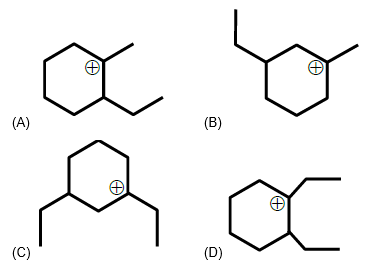
The cyclic cations having the same number of hyperconjugation are Choose the correct answer from the options given below : The four cyclic cations are: (A) the positive charge is on the ring carbon bearing a methyl group, with an ethyl group on the adjacent carbon; (B) the positive charge is on the ring carbon bearing a methyl group, with an ethyl group on a non-adjacent carbon; (C) the positive charge is on the ring carbon bearing an ethyl group, with a second ethyl group on a non-adjacent carbon; (D) the positive charge is on the ring carbon bearing an ethyl group, with a second ethyl group on the adjacent carbon. (A) = A, (B) = B, (C) = C, (D) = D.
Correct option: C. Method: The number of hyperconjugation structures equals the number of alpha-hydrogens: hydrogens on the carbons directly attached to the cationic carbon, including the alkyl group on the cationic carbon itself. (A) has 3 (methyl on C+) + 2 (CH2) + 1 (CH(Et)) = 6; (B) has 3 + 2 + 2 = 7; (C) has 2 (ethyl CH2 on C+) + 2 + 2 = 6; (D) has 2 + 2 + 1 = 5. (A) and (C) both have 6, so A and C only.
Q84 Apr 2026, Shift 2
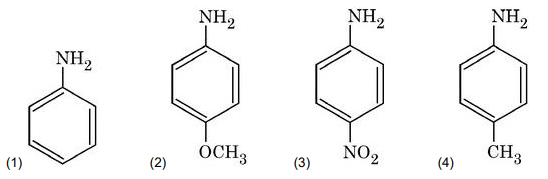
The strongest conjugate acid will result from: The four bases are: (1) aniline; (2) 4-methoxyaniline (p-anisidine); (3) 4-nitroaniline; (4) 4-methylaniline (p-toluidine). (1) = A, (2) = B, (3) = C, (4) = D.
Correct option: C. Method: The strongest conjugate acid comes from the weakest base. The nitro group in 4-nitroaniline (3) withdraws electrons by resonance, making it the weakest base of the four, so its conjugate acid is the strongest. The order of basicity is 4-methoxyaniline > 4-methylaniline > aniline > 4-nitroaniline.
Q94 Apr 2026, Shift 2
The descending order of acidity among the following compounds is: Choose the correct answer from the options given below: The five compounds are: (A) phenol; (B) 4-nitrophenol; (C) 4-methoxyphenol; (D) 4-nitrobenzoic acid; (E) benzoic acid.
Correct option: D. Method: Acidity falls in the order: 4-nitrobenzoic acid (D) is the strongest acid (a carboxylic acid with a para nitro group), then benzoic acid (E), then 4-nitrophenol (B), then phenol (A), then 4-methoxyphenol (C), which is the weakest (the para methoxy group donates by resonance). So the descending order is D > E > B > A > C.
Q104 Apr 2026, Shift 2
Consider the following molecules/species: The correct order of carbon - oxygen double bond length is : The three species are: (x) cyclohepta-2,4,6-trien-1-one (tropone); (y) acetone, (CH3)2C=O; (z) the acetate ion, CH3-COO−.
Correct option: D. Method: The C=O bond is shortest in acetone (y), a normal ketone C=O. In tropone (x) the C=O bond has considerable single-bond character from the aromatic tropylium-oxide resonance form, so it is longer than in acetone. In the acetate ion (z) the two C-O bonds are equivalent with bond order 1.5, the longest of the three. So the order is z > x > y. Note: options (B) and (C) are identical as printed (both read y > z > x); the key (D) is unaffected.
Q115 Apr 2026, Shift 1
Given below are two statements: Statement I: On the basis of inductive effect, the order of stability of alkyl carbanions is CH3−>CH3-CH2−>(CH3)2CH−>(CH3)3C− . Statement II: Allyl and benzyl carbanions are more stabilised by inductive effect and not by resonance effect. In the light of the above statements, choose the correct answer from the options given below
Correct option: C. Method: Statement I is correct: by the inductive effect, alkyl groups donate electrons and destabilise a carbanion, so the stability order is CH3− > CH3-CH2− > (CH3)2CH− > (CH3)3C−. Statement II is incorrect: allyl and benzyl carbanions are stabilised by resonance (delocalisation of the negative charge), not by the inductive effect. Statement I is correct but Statement II is incorrect.
Q125 Apr 2026, Shift 2
IUPAC name of the some alkenes are given below. Find out the correct stability order. A. 2-Methylbut-2-ene B. cis-But-2-ene C. 2,3-Dimethylbut-2-ene D. Prop-1-ene Choose the correct answer from the options given below :
Correct option: A. Method: Alkene stability rises with substitution (hyperconjugation): 2,3-dimethylbut-2-ene (C) is tetrasubstituted, 2-methylbut-2-ene (A) is trisubstituted, cis-but-2-ene (B) is disubstituted and prop-1-ene (D) is monosubstituted. So the order is C > A > B > D.
Q136 Apr 2026, Shift 1
Given below are two statements: Statement I: 2,6-diethylcyclohexanone and 6-methyl-2-n-propylcyclohexanone are metamers. Statement II: 2,2,6,6 - tetramethylcyclohexanone exhibits keto-enol tautomerism. In the light of the above statements, choose the correct answer from the options given below
Correct option: C. Method: Statement I is true: 2,6-diethylcyclohexanone and 6-methyl-2-n-propylcyclohexanone are metamers, the same ketone with different alkyl groups on the two sides of the carbonyl carbon. Statement II is false: 2,2,6,6-tetramethylcyclohexanone has no alpha-hydrogen (all four alpha positions carry methyl groups), so it cannot show keto-enol tautomerism. Statement I is true but Statement II is false.
Q148 Apr 2026, Shift 2
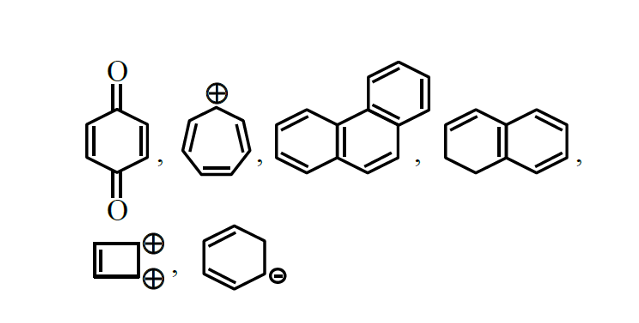
The total number of aromatic compounds/species from the following is The six species are: p-benzoquinone (cyclohexa-2,5-diene-1,4-dione); the tropylium cation (C7H7+); phenanthrene; a bicyclic dihydronaphthalene (two fused six-membered rings with four double bonds, partially saturated); the cyclobutadiene dication (a four-membered ring with one double bond and two positive charges); and the cyclohexadienyl anion (a six-membered ring with two double bonds and a negative charge on the saturated carbon).
Correct option: C. Method: Aromatic species are the tropylium cation (6 pi electrons), phenanthrene (14 pi electrons) and the cyclobutadiene dication (2 pi electrons). p-Benzoquinone is cross-conjugated and not aromatic, the dihydronaphthalene is partially saturated and not fully conjugated, and the cyclohexadienyl anion has an sp3 carbon that breaks the conjugation. So there are 3 aromatic compounds/species.
Pick an option for a multiple choice question, or type your answer for a numerical question and press Check. A correct choice turns green, a wrong choice turns red and the correct option turns green, and the short method appears below. Once answered, a card locks until you press Reset.
How many GOC questions are in this quiz, and from which years?
66 verified JEE Main GOC questions: 39 from 2024, 13 from 2025 and 14 from 2026, each in shift order.
How should I use this quiz for revision?
Attempt one year timed, without looking at the method. After checking, note every miss by pattern, such as inductive effect, resonance, or aromaticity, and rework that pattern the same day.
Do the questions cover both the January and April sessions?
Yes. The 2026 set covers both the January and April sessions, and the 2024 and 2025 sets cover their January and April sessions too.
Are these real JEE Main questions?
Yes. Every question here is a verified JEE Main GOC question from 2024, 2025 or 2026, shown with its shift.
Tags
JEE Main 2027GOC PYQJEE Main ChemistryPYQ AnalysisRepeat FrequencyUPO Unique PYQsGeneral Organic ChemistryInductive EffectResonanceJEE Main Preparation
Hello 👋 Welcome to Competishun – India’s most trusted platform for JEE & NEET preparation. Need help with JEE / NEET courses, fees, batches, test series or free study material? Chat with us now 👇