JEE Main Carbonyl Compounds PYQs 2024, 2025 and 2026: All Questions with Solutions
JEE Main Carbonyl Compounds PYQs 2024, 2025 and 2026: All Questions with Solutions
Verified JEE Main Carbonyl Compounds questions from 2024, 2025 and 2026, shift by shift. The 2024, 2025 and 2026 sets are interactive now: pick an option or enter a number and check instantly. Attempt timed, check the method only after answering, and log every miss by pattern.
How to use this quiz
1. Attempt one year timed, without looking at the method.
2. Click an option, or type a number and press Check, for instant right or wrong feedback.
3. Read the short method only after answering, then log the miss by pattern.
4. Rework your weak patterns the same day, then reattempt the year.
2024 Questions (3)
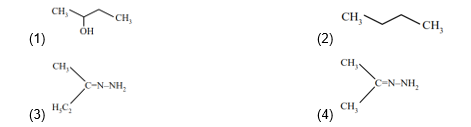
Identify ' A ' in the following reaction : Butan-2-one (CH3-CO-CH2-CH3) is treated with (i) N2H4 and (ii) ethylene glycol/KOH to give 'A'. The four options are: (1) butan-2-ol, CH3-CH(OH)-CH2-CH3; (2) n-butane, CH3-CH2-CH2-CH3; (3) the hydrazone of butan-2-one, CH3-C(=N-NH2)-CH2-CH3; (4) 2-hydrazino-2-methylbutane, (CH3)2C(NH-NH2)-CH2-CH3.

Which among the following aldehydes is most reactive towards nucleophilic addition reactions? The four options are aldehydes: (1) formaldehyde, H-CHO; (2) propanal, C2H5-CHO; (3) acetaldehyde, CH3-CHO; (4) butanal, C3H7-CHO.

Given below are two statements. Statement 1. Acidity of α-hydrogens of aldehydes and ketones is responsible for Aldol reaction. Statement II. Reaction between benzaldehyde and ethanal will NOT give Cross - Aldol product. In the light of above statements, choose the most appropriate answer from the options given below.
UPO
Unique PYQs Only. Solve only what is new.
✓4,348 unique PYQs
✓Repeated questions grouped in clusters
PYQ Express
Every JEE Main PYQ in one place.
✓10,000+ PCM PYQs
✓Physics, Chemistry, Maths
2025 Questions (19)
Residue (A) + HCl (dil) → Compound (B) Structure of residue (A) and compound (B) formed respectively is : Toluene (excess) is treated with (i) CrO2Cl2, CS2, (ii) H3O+ and (iii) NaHSO3, then filtered to give residue (A). The four options give pairs ([A], [B]): (1) benzaldehyde and benzoic acid; (2) Ph-CH(OCrOHCl2)2 and benzaldehyde; (3) Ph-CH(OH)-SO3Na and benzaldehyde; (4) benzaldehyde and sodium benzoate.


A compound 'X' absorbs 2 moles of hydrogen and 'X' upon oxidation with KMnO4/H+ gives the products shown in the figure. The total number of sigma bonds present in the compound 'X' is ____. Oxidation of 'X' with KMnO4/H+ gives three products: acetone (CH3-CO-CH3), acetic acid (CH3-COOH) and 4-oxopentanoic acid (CH3-CO-CH2-CH2-COOH).

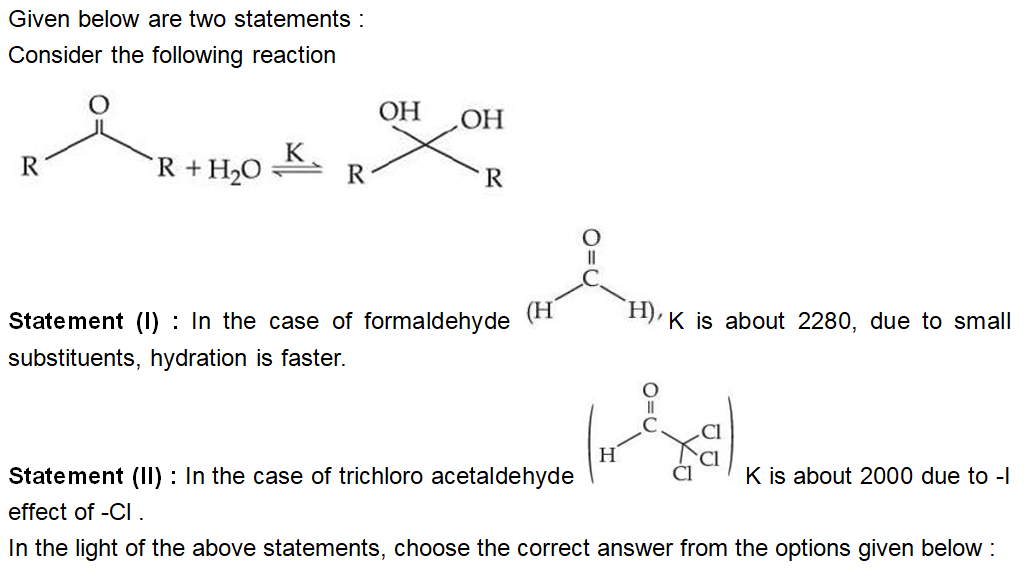
Given below are two statements: Consider the reaction R2C=O + H2O ⇌ R2C(OH)2 with equilibrium constant K. Statement (I): In the case of formaldehyde (H-CHO), K is about 2280, due to small substituents, hydration is faster. Statement (II): In the case of trichloroacetaldehyde (chloral, CCl3-CHO), K is about 2000 due to -I effect of -Cl. In the light of the above statements, choose the correct answer from the options given below:
Which of the following arrangements with respect to their reactivity in nucleophilic addition reaction is correct?
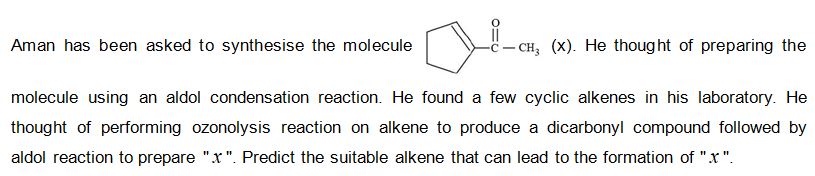
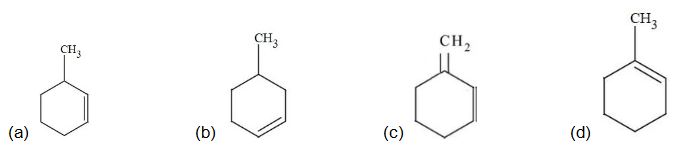
Aman has been asked to synthesise the molecule (x), 1-acetylcyclopent-1-ene (a cyclopentene ring bearing a CO-CH3 group on the double bond carbon). He thought of preparing it using an aldol condensation reaction. He found a few cyclic alkenes in his laboratory. He thought of performing ozonolysis on an alkene to produce a dicarbonyl compound followed by aldol reaction to prepare 'x'. Predict the suitable alkene that can lead to the formation of 'x'. The four options are: (a) 4-methylcyclohexene, (b) 3-methylcyclohexene, (c) methylenecyclohexane, (d) 1-methylcyclohexene.
Match List - I with List - II. Choose the correct answer from the options given below : List-I: (A) RCN --(i) SnCl2, HCl (ii) H3O+-→ RCHO; (B) benzoyl chloride --H2, Pd-BaSO4−→ benzaldehyde; (C) toluene --(i) CrO2Cl2, CS2 (ii) H3O+-→ benzaldehyde; (D) benzene --(i) CO, HCl (ii) anhydrous AlCl3/CuCl−→ benzaldehyde. List-II: (I) Etard reaction, (II) Gatterman-Koch reaction, (III) Rosenmund reduction, (IV) Stephen reaction.

Both acetaldehyde and acetone (individually) undergo which of the following reactions? A. Iodoform Reaction B. Cannizzaro Reaction C. Aldol Condensation D. Tollen's Test E. Clemmensen Reduction Choose the correct answer from the options given below:
0.1 mole of compound 'S' will weigh ______ g. (Given atomic masses in g mol-1: C: 12, H: 1, O: 16) 2-(Hydroxymethyl)cyclopentan-1-ol is treated with excess CrO3 to give P; P with one mole of ethane-1,2-diol under H+ gives Q; Q with (1) CH3MgBr in ether and (2) H3O+ gives R; R with (1) NaBH4 and (2) H2O gives compound S.

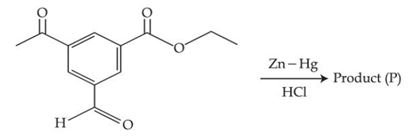
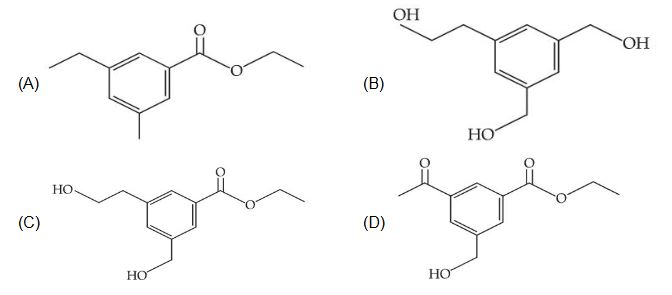
The product (P) formed in the following reaction is : A benzene ring bearing a CO-CH3 group, a CO2Et group and a CHO group is treated with Zn-Hg/HCl to give product (P). The four options are: (A) ethyl 3-ethyl-5-methylbenzoate; (B) a benzene ring bearing CH2CH2OH, CH2OH and CH2OH groups; (C) a benzene ring bearing HO-CH2-CH2−, HO-CH2− and CO2Et groups; (D) a benzene ring bearing CO-CH3, CO2Et and CH2OH groups.
Total number of nucleophiles from the following is : The species listed are: NH3, PhSH, (CH3)2S, H2C=CH2, OH−, H3O+, (CH3)2CO and CH3NC (methyl isocyanide).

In the Claisen-Schmidt reaction to prepare, dibenzalacetone from 5.3 g of benzaldehyde, a total of 3.51 g of product was obtained. The percentage yield in this reaction was ____ %.
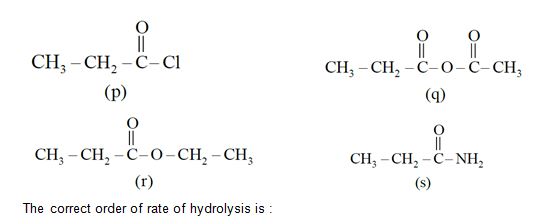
Consider the following molecules : The four molecules are: (p) propanoyl chloride, CH3-CH2-CO-Cl; (q) propanoic acetic anhydride, CH3-CH2-CO-O-CO-CH3; (r) ethyl propanoate, CH3-CH2-CO-O-CH2-CH3; (s) propanamide, CH3-CH2-CO-NH2. The correct order of rate of hydrolysis is:
Number of molecules from below which cannot give iodoform reaction is: Ethanol, Isopropyl alcohol, Bromoacetone, 2-Butanol, 2-Butanone, Butanal, 2-Pentanone, 3-Pentanone, Pentanal and 3-Pentanol.
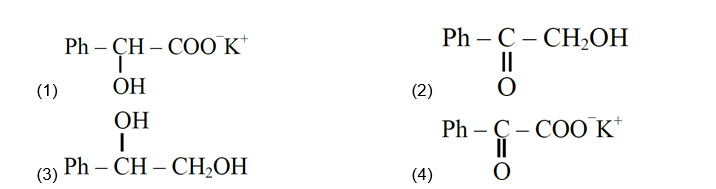
The major product in the following reaction is : Phenylglyoxal, Ph-CO-CHO, is treated with KOH with heat to give major product P. The four options are: (1) Ph-CH(OH)-COO− K+; (2) Ph-CO-CH2OH; (3) Ph-CH(OH)-CH2OH; (4) Ph-CO-COO− K+.

An organic compound (X) with molecular formula C3H6O is not readily oxidised. On reduction it gives C3H8O(Y) which reacts with HBr to give a bromide (Z) which is converted to Grignard reagent. This Grignard reagent on reaction with (X) followed by hydrolysis give 2,3-dimethylbutan-2-ol. Compounds (X),(Y) and (Z) respectively are:
Which among the following compounds give yellow solid when reacted with NaOI/NaOH? The five compounds are: (A) butan-2-ol, CH3-CH(OH)-CH2-CH3; (B) propan-1-ol, CH3-CH2-CH2-OH; (C) butan-2-one, CH3-CO-CH2-CH3; (D) acetic acid, CH3-COOH; (E) propanal, CH3-CH2-CHO.

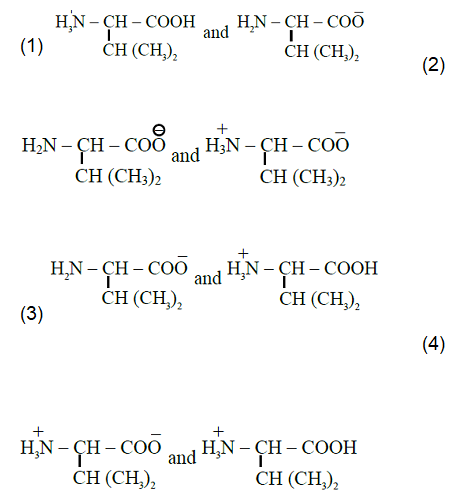
Choose the correct option for structures of A and B, respectively Valine, (CH3)2CH-CH(NH2)-COOH, is taken to pH = 2 to give A and to pH = 10 to give B. The four options give pairs (A, B): (1) H3N+-CH(COOH)-CH(CH3)2 and H2N-CH(COO−)-CH(CH3)2; (2) H2N-CH(COO−)-CH(CH3)2 and H3N+-CH(COO−)-CH(CH3)2; (3) H2N-CH(COO−)-CH(CH3)2 and H3N+-CH(COOH)-CH(CH3)2; (4) H3N+-CH(COO−)-CH(CH3)2 and H3N+-CH(COOH)-CH(CH3)2.

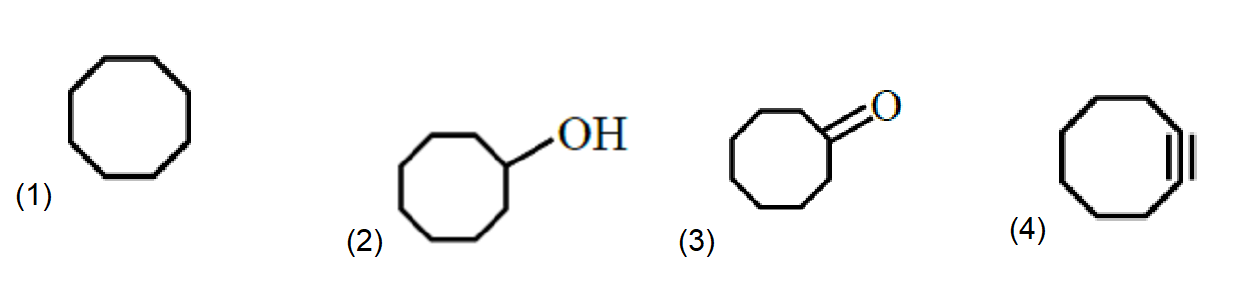
1,2-Dibromocyclooctane is treated with (i) KOH (alc.), (ii) NaNH2, (iii) Hg2+/H+, (iv) Zn-Hg/H+ to give major product P. The four options are: (1) cyclooctane; (2) cyclooctanol; (3) cyclooctanone; (4) cyclooctyne.

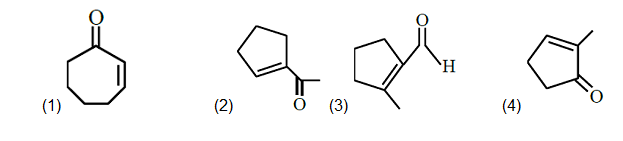
When 6-oxoheptanal (CH3-CO-CH2-CH2-CH2-CH2-CHO) undergoes intramolecular aldol condensation, the major product formed is: The four options are: (1) cyclohept-2-en-1-one; (2) 1-acetylcyclopent-1-ene; (3) 2-methylcyclopent-1-ene-1-carbaldehyde; (4) 2-methylcyclopent-2-en-1-one.

JEE Mates
Online Mock Test Series.
✓50 online mock tests
✓Video solutions + analysis
UTS
Ultimate Test Series.
✓20 full mocks + 6 special tests
✓Projected percentile after every test
2026 Questions (23)
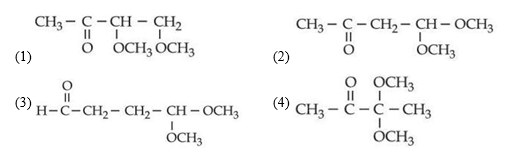
An organic compound " P " of molecular formula C6H12O3 gives positive iodoform test but negative Tollen's test. When " P " is treated with dilute acid, it produces " Q ". " Q " gives positive Tollen's test and also iodoform test. The structure of " P " is : The four options are: (1) 3,4-dimethoxybutan-2-one, CH3-CO-CH(OCH3)-CH2-OCH3; (2) 4,4-dimethoxybutan-2-one, CH3-CO-CH2-CH(OCH3)2; (3) 4,4-dimethoxybutanal, OHC-CH2-CH2-CH(OCH3)2; (4) 3,3-dimethoxybutan-2-one, CH3-CO-C(CH3)(OCH3)2.
Match List-I with List-II. Choose the correct answer from the options given below: Match List-I with List-II. List-I (Reagents): A. H2, Pd-BaSO4; B. SnCl2, HCl; C. CrO2Cl2, CS2; D. CO, HCl, anhyd. AlCl3. List-II (Reaction name, involving aldehydes): I. Etard reaction; II. Rosenmund reduction; III. Gatterman-Koch reaction; IV. Stephen reaction.

The compound A, C8H8O2 reacts with acetophenone to form a single product via cross-Aldol condensation. The compound A on reaction with conc. NaOH forms a substituted benzyl alcohol as one of the two products. The compound A is :
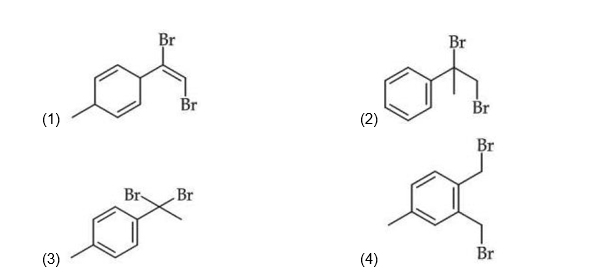
The dibromo compound [P] (molecular formula: C9H10Br2 ) when heated with excess sodamide followed by treatment with dilute HCl gives [Q]. On warming [Q] with mercuric sulphate and dilute sulphuric acid yield [R] which gives positive iodoform test but negative Tollen's test. The compound [P] is : The four options are: (1) 2,2-dibromo-1-(p-tolyl)ethene; (2) 1,1,2-tribromo-1-phenylethane; (3) 1,1-dibromo-1-(p-tolyl)ethane; (4) 1,2-dibromo-1-(p-tolyl)ethane.
Compound ‘P’ undergoes the following sequence of reactions : ‘P’ is : Compound P is treated with (i) NH3 and (ii) heat to give Q; Q is treated with (i) KOH, Br2 and (ii) CHCl3, KOH (alc.), heat to give cyclohexyl isocyanide. The four options are: (1) 2-cyclohexylacetaldehyde; (2) cyclohexanecarboxylic acid; (3) cyclohexyl ethyl ketone; (4) cyclohexanecarboxamide.


' x ' is the product which is obtained from propanenitrile and stannous chloride in the presence of hydrochloric acid followed by hydrolysis. ' y ' is the product which is obtained from the but-2-ene by the ozonolysis followed by hydrolysis. From the following, which product is not obtained when one mole of ' x ' and one mole of ' y ' react with each other in the presence of alkali followed by heating?
Benzene is treated with CH3-CO-CH2-CH2-CO-Cl and anhydrous AlCl3 to give (P); (P) with aq. NaOH and heat gives (Q). In compound (Q), the percentage of oxygen is ____ %. (Nearest integer)

Which of the following statements are TRUE about Haloform reaction?: A. Sodium hypochlorite reacts with KI to give KOI. B. KOI is a reducing agent. C. An alpha,beta-unsaturated methyl ketone (CH3-CH=CH-CO-CH3) will give iodoform reaction. D. Isopropyl alcohol will not give iodoform test. E. Methanoic acid will give positive iodoform test. Choose the correct answer from the options given below:

iodoform test can differentiate between A. Methanol and Ethanol B. CH3COOH and CH3CH2COOH C. Cyclohexene and cyclohexanone D. Diethyl ether and Pentan-3-one E. Anisole and acetone Choose the correct answer from the options given below:
Grignard reagent RMgBr(P) reacts with water and forms a gas (Q). One gram of Q occupies 1.4 dm3 at STP. (P) on reaction with dry ice in dry ether followed by H3O+forms a compound (Z). 0.1 mole of (Z) will weigh g. (Nearest integer)
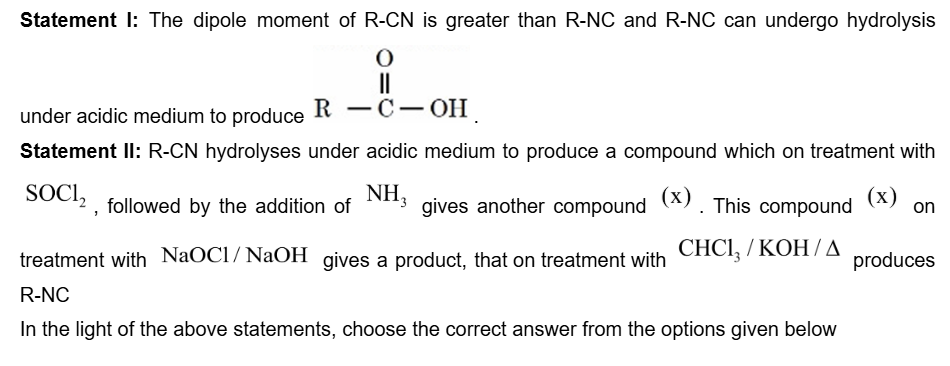
Given below are two statements: Statement I: The dipole moment of R-CN is greater than R-NC and R-NC can undergo hydrolysis under acidic medium to produce R-COOH. Statement II: R-CN hydrolyses under acidic medium to produce a compound which on treatment with SOCl2, followed by the addition of NH3 gives another compound (x). This compound (x) on treatment with NaOCl/NaOH gives a product, that on treatment with CHCl3/KOH/heat produces R-NC. In the light of the above statements, choose the correct answer from the options given below.
Given below are two statements: Statement I: Cross aldol condensation between two different aldehydes will always produce four different products. Statement II: When semicarbazide reacts with a mixture of benzaldehyde and acetophenone under optimum pH , it forms a condensation product with acetophenone only. In the light of the above statements, choose the correct answer from the options given below
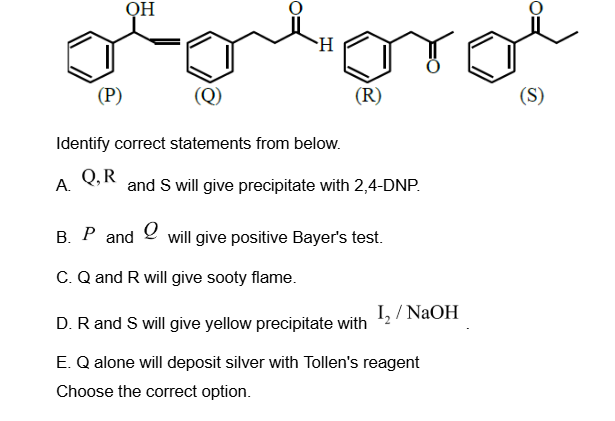
Given below are the four isomeric compounds (P,Q, S) The four isomeric compounds are: (P) 1-phenylprop-2-en-1-ol, Ph-CH(OH)-CH=CH2; (Q) 3-phenylpropanal, Ph-CH2-CH2-CHO; (R) 1-phenylpropan-2-one, Ph-CH2-CO-CH3; (S) propiophenone, Ph-CO-CH2-CH3. Identify correct statements from below. A. Q, R and S will give precipitate with 2,4-DNP. B. P and Q will give positive Baeyer's test. C. Q and R will give sooty flame. D. R and S will give yellow precipitate with I2/NaOH. E. Q alone will deposit silver with Tollen's reagent. Choose the correct option.
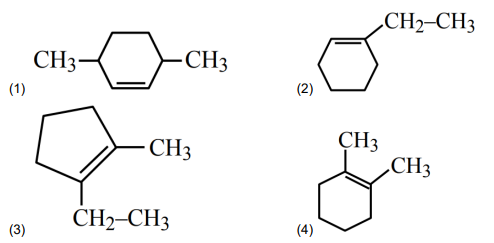
Given below are two statements for the following reaction sequence. Compound 'X' (molecular formula C3H6Cl2) is treated with excess NaNH2 to give compound 'Y'. 'Y' with dil. H2SO4 and Hg2+ gives compound 'Z', and with heat over a red hot iron tube gives compound 'Q' (molecular formula C9H12). Statement I: Compound 'Z' will give yellow precipitate with NaOI. Statement II: Compound 'Q' has two different types of 'H' atoms (aromatic : aliphatic) in the ratio 1 : 3. In the light of the above statements, choose the correct answer from the options given below:
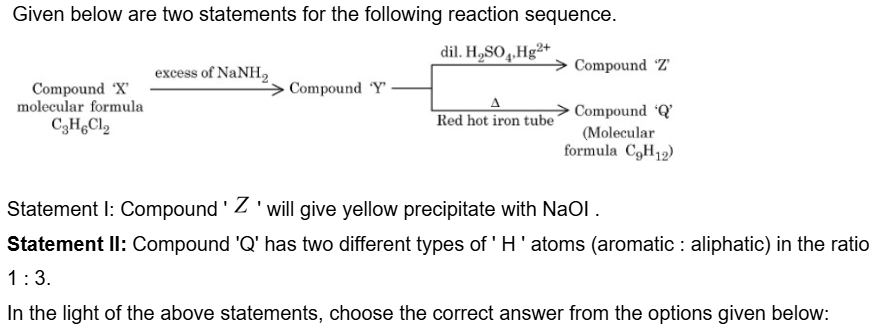
A student performed analysis of aliphatic organic compound ' X ' which on analysis gave C=61.01 %, H=15.25 %, N=23.74 %. This compound, on treatment with HNO2 / H2O produced another compound ' Y ' which did not contain any nitrogen atom. However, the compound ' Y ' upon controlled oxidation produced another compound ' Z ' that responded to iodoform test. The structure of ' X ' is : The four options are: (1) n-propylamine, CH3-CH2-CH2-NH2; (2) sec-butylamine, CH3-CH2-CH(NH2)-CH3; (3) isopropylamine, (CH3)2CH-NH2; (4) 1-phenylethanamine, Ph-CH(NH2)-CH3.
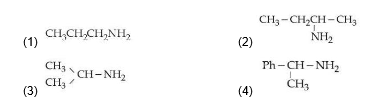
An organic compound " x " where molar ratio of C, O and H are equal, on treatment with 50 % KOH under reflux followed by acidification produced " y ". The most likely structure of " y " is : [Molar mass of ' x ' is 58 g mol−1 ] The four options are structures numbered (1) to (4): (1) acrylic acid, CH2=CH-COOH; (2) crotonaldehyde, CH3-CH=CH-CHO; (3) glycolic acid, HO-CH2-COOH; (4) acetic acid, CH3-COOH.
Consider the following sequence of reactions to give the major product (X) P g of the major product (X) formed is reacted with NaHCO3 solution to liberate a gas which occupied 11.2 dm3 at STP. P=... g . (Given molar mass in gmol−1 H: 1 . C: 12 . O: 16 . Cl: 35.5 ) Benzene is treated with (i) CH3Cl/anhydrous AlCl3, (ii) Cl2/FeCl3 and (iii) K2Cr2O7/H2SO4 to give major product (X).

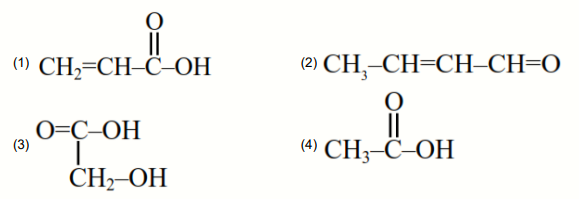
" P " is a hydrocarbon of molecular formula:- C8H14. On ozonolysis, " P " forms "Q". "Q" on treatment with alkali under reflux condition produces " R ", which on treatment with I2 / NaOH gives a yellow precipitate. Acidification of the solution gives " S ". The structure of " S " is given below:- The correct structure of “P” is The structure of 'S' is 2-methylcyclopent-1-ene-1-carboxylic acid (a cyclopentene ring bearing a CH3 group and a COOH group on the two carbons of the double bond). The four options for P are: (1) 1,4-dimethylcyclohex-2-ene; (2) 1-ethylcyclohex-1-ene; (3) 1-ethyl-2-methylcyclopent-1-ene; (4) 1,2-dimethylcyclohex-1-ene.

Given below are two statements : In the light of the above statements, choose the correct answer from the options given below: Statement I: The condensation reaction between ethanal (CH3-CHO) and semicarbazide (H2N-NH-CO-NH2) under optimum pH will produce the semicarbazone drawn with the amide-side NH2 bound to the imine nitrogen (CH3-CH=N-CO-NH-NH2). Statement II: The molecule Ph-CH(OH)-OCH3 will generate Ph-CHO in the presence of dilute acid.

Complete the following reaction sequence and give the name of major product ‘P’ Propanenitrile (CH3-CH2-C≡N) is treated with (i) OH−/H2O with heat, (ii) H3O+, (iii) Cl2/Red P and (iv) H2O to give major product P.

' x ' is the product which is obtained by the hydrolysis of prop-1-yne in the presence of mercuric sulphate under dilute acidic medium at 333 K . ' y ' is the product which is obtained by the reaction of ethane nitrile with methyl magnesium bromide in dry ether followed by hydrolysis. IUPAC name of product obtained from ' x ' and ' y ' in the presence of barium hydroxide followed by heating is :
' x ' is the product which is obtained from benzene by reacting it with carbon monoxide and hydrogen chloride in the presence of cuprous chloride. ' y ' is the major product obtained from the benzene by reacting it with ethanoyl chloride in the presence of anhydrous AlCl3. Product (major) obtained by heating x and y in the presence of alkali is z . Total number of π(p i) electrons in z is ____
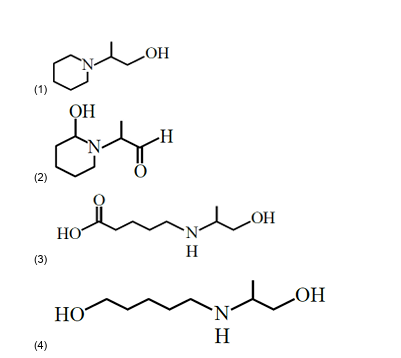
Consider the following reaction. The major product (P) formed is : The substrate is a six-membered lactam (piperidin-2-one) whose nitrogen bears a CH(CH3)-CHO group; it is treated with (i) NaBH4/MeOH, (ii) NaOH(aq) with heat and (iii) H3O+ to give major product (P). The four options are: (1) 1-(2-hydroxypropyl)piperidine; (2) 2-hydroxy-1-(1-formylethyl)piperidine; (3) 5-[(2-hydroxypropyl)amino]pentanoic acid, HOOC-CH2-CH2-CH2-CH2-NH-CH(CH3)-CH2-OH; (4) 6-[(2-hydroxypropyl)amino]hexan-1-ol.

Chemistry PYQ Book
JEE Main 5 Years Chemistry PYQ Book 2022-2026.
✓Chapter-wise solved papers
✓Detailed solutions
JEE Advanced Online
Online Mock Test Series.
✓10 online mock tests
✓Video solutions + analysis
Frequently Asked Questions
Tags