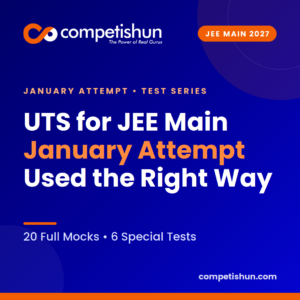
UTS for JEE Main 2027 January Attempt: 20 Full Mocks and 6 Special Tests, Used the Right Way
JEE Main 2027 January Attempt · Competishun
UTS for JEE Main 2027 January Attempt: 20 Full Mocks and 6 Special Tests, Used the Right Way
TEST SERIES GUIDE BY
Mohit Tyagi Sir (MT Sir)
Mathematics Faculty · B.Tech, IIT Delhi · 25 years of teaching experience
A test series helps only if every mock is followed by analysis and revision. The 20 full mocks in UTS build stamina, time management and question selection under full paper pressure, while the 6 special tests repair the weak areas your analysis finds. Attempt every mock under exam conditions, analyse it the same day, revise what it exposes, and treat the projected percentile as direction, not a verdict. That cycle, repeated honestly, is what turns a test series into marks.
In the January attempt phase, most students face a strange problem: they know a lot, but their scores do not show it. Chapters are covered, formulas are revised, and previous year questions feel familiar, yet a full paper still ends in a rush, with easy questions left unattempted and silly mistakes scattered across all three subjects. The gap is not knowledge. It is performance, and performance is trained only by rehearsing the exam itself.
That is what a mock test series is for. It does not teach you new theory. It teaches you to deliver what you already know inside a three-hour paper, under time pressure, with the freedom to choose your order and the discipline to leave questions alone. UTS, the test series for the JEE Main 2027 January attempt, is built around that job: 20 full-syllabus mock tests on the latest NTA pattern, plus 6 special tests for targeted practice, with detailed performance analysis, solutions, and a projected percentile after every test.
This guide explains how to use such a series properly: what full mocks train, what special tests are for, how to analyse every mock, how to read a projected percentile without fooling yourself, how to balance mocks with PYQ practice, the mistakes that waste a test series, and a sample week plan you can start from. The series gives you the tests. This guide gives you the method.
In this guide
- Why mock tests matter most in the January attempt phase
- What the 20 full mocks train
- What the 6 special tests are for
- The attempt analyse revise cycle for every mock
- How to read your performance analysis
- Projected percentile: what it means and what it does not
- Mock tests vs PYQs: getting the balance right
- Common mock test mistakes to avoid
- A sample mock week plan
- FAQs
Why Mock Tests Matter Most in the January Attempt Phase
In the January attempt phase, your preparation changes character. Earlier, the job was to cover the syllabus: learn chapters, solve exercises, and build concepts one topic at a time. Now the job is to convert that preparation into a score in a single sitting. Chapter practice cannot teach that conversion, because chapter practice never asks you to switch subjects, manage a clock, or decide which questions deserve your time.
A full mock is the only practice that reproduces the real exam. It puts the whole syllabus in front of you at once, under the same time pressure, and forces the same decisions the real paper will force: which subject to start with, which question to attempt first, when to mark and move on, and when to stop chasing a question that is eating your paper. Students who never rehearse those decisions discover them for the first time on exam day, and that discovery is expensive.
Mocks also expose problems that chapter practice hides. A chapter you rate as strong may still leak marks when it appears late in a paper, after two hours of concentration. A subject you enjoy may quietly consume time that belongs to the other two. Silly mistakes, which feel rare in relaxed practice, multiply under pressure. A mock shows you all of this in advance, while there is still time to fix it.
There is a third benefit that students underestimate: temperament. The first few full papers feel uncomfortable, even for well-prepared students. That discomfort is the training. By the fifth or sixth mock, the clock stops feeling like an enemy, switching subjects feels normal, and leaving a hard question feels like a decision rather than a defeat. On exam day, you want that calm to be a habit, not a hope.
What the 20 Full Mocks Train
A full mock covers the entire syllabus in one sitting, the way the real paper does. That single property is what makes it different from every other form of practice, and it trains five things that nothing else can train together.
- Stamina: staying sharp through the full length of a paper, including the final stretch where most silly mistakes happen.
- Time discipline: learning your real pace, discovering which subject eats your time, and practising the habit of moving on instead of sinking minutes into one question.
- Subject switching: moving between Physics, Chemistry and Mathematics without losing rhythm, the way the real paper demands.
- Question selection: choosing which questions to solve first, which to mark for later, and which to leave entirely. Selection is a scoring skill, not a side effect.
- Full-syllabus balance: revising all three subjects together, so that a strong subject does not hide a weak one until exam day.
Twenty full mocks give you room to improve in stages. The early mocks are diagnostic: they show you your real starting point, your pace, and your weakest subject. The middle mocks are where you test changes: a new subject order, a stricter skip rule, a different time split. The later mocks are dress rehearsals: by then, your attempt pattern should feel settled, and the paper should feel familiar rather than frightening.
One warning applies to all twenty: a full mock only trains these skills if you attempt it under exam conditions. That means the full paper in one sitting, a clock running, no breaks in the middle, no peeking at solutions, and no pausing to revise a formula mid-paper. A mock solved casually, in pieces, across a whole day, trains nothing except the feeling of having solved questions.
What the 6 Special Tests Are For
If full mocks measure your preparation, special tests repair it. A full mock tells you that something is weak. A special test lets you work on that one weakness alone, without paying the price of another full paper. That division of labour is the whole point of having both types of test in one series.
Use a special test when your analysis points to one clear problem. It could be a subject that consistently scores lower than the other two, a group of chapters that keeps losing marks, or a skill problem such as slow calculation or careless reading. Instead of retaking a full mock and hoping the same weakness appears again, a special test puts you back in front of that weakness directly, so the repair work is concentrated where it is needed.
Special tests are also useful for skills that a full mock cannot isolate. Speed practice, accuracy practice, and question selection practice all improve faster when the test is short and focused, because you can see the effect of one change immediately. A student who rushes through full mocks never learns whether the problem is knowledge, speed, or selection. A special test separates those causes.
| Full mocks (20) | Special tests (6) | |
|---|---|---|
| Purpose | Measure your preparation under real exam conditions | Repair a specific weakness found by analysis |
| Coverage | Full syllabus, all three subjects together | Targeted practice for one area or skill at a time |
| When to use | On a fixed rhythm through the January attempt phase | After a full mock, when analysis points to one clear problem |
| What it teaches | Stamina, time management, question selection, temperament | Depth in a weak area, speed, accuracy, and selection discipline |
| What to do after | Analyse the full paper the same day and log every lesson | Revise the targeted area and carry the fix into the next full mock |
| Full mocks measure, special tests repair. A test series works when both jobs keep feeding each other. | ||
Swipe the table sideways to see all columns
The balance matters. Students who attempt only full mocks keep measuring the same weaknesses without ever repairing them. Students who attempt only short targeted tests never learn to hold a full paper together. The series is designed so that the two types alternate: measure with a full mock, repair with a special test, and measure again to confirm the repair worked.
The Attempt Analyse Revise Cycle for Every Mock
A mock test only helps if it is followed by analysis and revision. Without those two steps, a mock is just a score, and scores by themselves have never improved anyone. The cycle below should follow every single mock, full or special, without exception.
Four steps after every mock
Attempt under exam conditions
Solve the full paper in one sitting, with a clock running and no solutions in reach.
Honest measurementAnalyse the same day
Check accuracy, time per question, weak chapters, and the type of every error.
Find the real leaksRevise what the analysis found
Go back to the concepts, formulas, and chapters that actually lost marks.
Repair, not re-readingCarry lessons forward
Write down one or two attempt rules for the next mock, and follow them.
Visible improvementStep 2 deserves the most care, because it decides whether steps 3 and 4 even happen. Analysis is not reading the solutions to the questions you got wrong. Analysis is sorting your errors: which questions were concept gaps, which were silly mistakes, and which were time problems. Each type needs a different fix, and a solution alone will not tell you which type you are looking at.
Step 4 is where most students stop short. After analysis, write down the lessons in plain words: skip faster in Physics, attempt Chemistry first, never spend more than a few minutes on a single question in the first round. Carry those rules into the next mock deliberately. If the same mistake appears in the next analysis, the rule was not followed, and that itself is useful information.
How to Read Your Performance Analysis
Performance analysis turns a score into a study plan. A single number tells you how a mock went. Analysis tells you what to do next, and it works best when you read it in the same order every time, so that no leak hides behind a good overall score.
| What to check | What it tells you | What to do next |
|---|---|---|
| Overall score and accuracy | Your general level on that paper, and how many attempted questions were actually correct | Compare with your previous mocks, not with other students, and look for a trend |
| Time per question | Whether you are slow overall, or slow only in one subject or question type | Set a per-question time rule for the next mock and practise it deliberately |
| Subject-wise accuracy | Which subject is pulling your score up, and which one is pulling it down | Give the weakest subject the next revision slots, not the subject you enjoy most |
| Chapter-wise weak areas | The exact chapters where marks are being lost again and again | Revise those chapters first, then use a special test to confirm the repair |
| Silly mistakes vs concept gaps | Whether marks are lost to carelessness, or to chapters you have not understood | Fix silly mistakes with checking habits; fix concept gaps with re-study, not more mocks |
| Questions skipped | Whether you skipped wisely, or left doable questions unattempted | Review skipped questions: the doable ones should have been attempted, the traps rightly left |
| Read analysis in this order every time: score, time, subjects, chapters, error types, skipped questions. | ||
Swipe the table sideways to see all columns
Start with the biggest leak, not with everything at once. If time is the problem, fixing time discipline will lift all three subjects together. If one subject is far behind, that subject deserves the next few revision days. Trying to fix every weakness in one week usually fixes none of them.
Track the same metrics across mocks. One mock can mislead: a paper may suit your strengths, or punish them unfairly. Three mocks in a row tell the truth. If accuracy in a subject rises across three mocks, the repair is working. If time per question stays high, the skip rule is not being followed. Trends, not single scores, should decide your study plan.
Projected Percentile: What It Means and What It Does Not
After every mock, a test series shows you a projected percentile: an estimate of where your score would place you among the students who took that mock, adjusted for the difficulty of that paper. Used properly, it is a useful compass. It tells you whether your preparation is moving in the right direction, and it lets you compare mocks of different difficulty levels on a common scale.
What it does not do is predict your real result. The real exam has a different paper, a different and much larger group of students, and a difficulty level nobody can know in advance. A projected percentile from one mock is therefore an estimate built on that mock alone, and it can move for reasons that have nothing to do with your preparation: an easier paper, a smaller group, or a paper that happened to suit your strong chapters.
That is why the trend matters more than any single number. If your projected percentile rises steadily across several mocks, your preparation is genuinely improving. If it jumps up and down wildly, the papers are varying more than your preparation is, and you should look at accuracy and weak chapters instead. And if it falls, do not panic: read the analysis, find the leak, and fix it. A falling number is a message, not a verdict.
Mock Tests vs PYQs: Getting the Balance Right
In the January attempt phase, students often ask whether they should solve mocks or previous year questions. The honest answer is both, because they train different skills, and dropping either one leaves a gap that the other cannot fill.
Previous year questions teach you the patterns of the real exam: the question styles that repeat, the chapters that carry weight, the standard traps, and the level of calculation the paper actually demands. They are the closest thing to the real paper that exists, and they teach you what to expect. Mocks, by contrast, teach you performance: how to hold a full paper together, manage time, select questions, and stay calm when a question resists you. One teaches content, the other teaches delivery.
A practical balance looks like this. Let mocks set your rhythm: attempt them on a fixed schedule, analyse each one, and let the analysis decide your revision. Let PYQs fill the gaps the analysis finds: when a mock exposes a weak chapter, go back to that chapter's previous year questions before the next mock, so the repair is built on real exam questions rather than guesswork. In the final weeks, keep both running, but let mocks take the larger share, because by then the exam itself, not new learning, is what needs rehearsing.
Two extremes should be avoided. Solving only mocks, with no PYQ practice, leaves you fast but unfamiliar with real question patterns. Solving only PYQs, with no full papers, leaves you knowledgeable but untested under time pressure. The January attempt phase rewards the student who keeps both skills sharp at the same time.
Common Mock Test Mistakes to Avoid
Most students do not waste a test series by choosing the wrong series. They waste it by using a good series badly. These are the mistakes to watch for in your own routine:
- Solving without analysis: attempting mock after mock and never reading the analysis. The score is recorded, but nothing is learned, and the same mistakes repeat in every paper.
- Too many mocks, no revision: filling the week with tests and leaving no days for repairing what the tests exposed. Mocks measure, revision improves, and a week without revision is a week without improvement.
- Ignoring time discipline: solving mocks without a clock, or pausing mid-paper to revise a formula. A mock attempted casually trains nothing about real exam pressure.
- Attempting every question: practising the habit of forcing every question, including traps, instead of practising selection. What you rehearse in mocks is what you will do on exam day.
- Chasing the percentile after every mock: changing the study plan because one number moved, instead of trusting the trend across several mocks.
- Leaving strong chapters unrevised: trusting that a chapter you already know well needs no further touch, when even your best chapters fade without short revisits.
Every one of these mistakes has the same root: treating the mock as the goal instead of the training. The goal is the real paper. The mock is the rehearsal room, and rehearsal only works when every session ends with notes on what to fix.
A Sample Mock Week Plan
A test series needs a weekly rhythm, or it collapses into random attempts. The plan below balances full mocks, special tests, analysis, revision, and PYQ practice, with one genuine rest day, because a tired mind learns nothing. Treat it as a starting template and adjust it to your level: if analysis shows a large concept gap, replace a mock with a revision day, and if your scores are stable, keep the rhythm unchanged.
| Day | Focus | What to do |
|---|---|---|
| Day 1 | Full mock | Attempt one full mock under exam conditions, full paper in one sitting with a clock running. |
| Day 2 | Analysis and error log | Analyse the mock the same way every time: accuracy, time, subjects, chapters, error types, skipped questions. Write down the lessons. |
| Day 3 | Special test and repair | Attempt a special test for the weakest area found, then revise that area properly. |
| Day 4 | PYQ practice | Solve previous year questions from the weak chapters, and revise the formulas they use. |
| Day 5 | Full mock | Attempt the next full mock, deliberately following the rules written down after the last analysis. |
| Day 6 | Analysis and revision | Analyse the second mock, compare its trend with the first, and revise what still leaks marks. |
| Day 7 | Rest and light revision | No new mock. Light formula revision, error log review, and rest, so the next week starts fresh. |
| Two full mocks, one special test, two analysis days, and one rest day: a week that improves, not just occupies. | ||
Swipe the table sideways to see all columns
Notice what the plan protects: analysis gets its own days, revision gets its own days, and rest gets its own day. A plan with only mocks and no analysis days will feel busy and achieve little. A plan that respects the full cycle will feel slower in the first week and visibly better by the third.
UTS: Ultimate Test Series
Full-syllabus mock tests on the latest NTA pattern, plus special tests for targeted practice, with detailed performance analysis, solutions, and a projected percentile after every test.
Competishun Test Series
Chapter, part and full-syllabus tests on the real CBT pattern, with All India comparison and detailed analysis of accuracy, time taken and weak chapters.
Use Every Mock Like It Counts
Attempt the mock, analyse it the same day, revise what it exposes, and carry the lessons into the next one. That cycle, repeated across the series, is what turns practice into a January attempt score.
About Competishun
Competishun is an online JEE and NEET coaching platform with programs for Class 11, Class 12 and droppers, PYQ courses and books, study material and an All India Test Series, taught by experienced senior faculty. More than 2.2 million students follow the Competishun YouTube channel for free concept lectures and PYQ solutions.
Free JEE Lectures and Test Guidance
Follow Competishun for free concept lectures, PYQ solutions and JEE Main 2027 updates.
Read These Next
20 full mocks and 6 special tests on the latest NTA pattern, with analysis, solutions and projected percentile.
Full-length CBT mocks and chapter tests with All India comparison and detailed analysis.
The 3-round attempt strategy, skip rules and a 180-minute plan for the real paper.
Frequently Asked Questions
Tags
About the Teacher
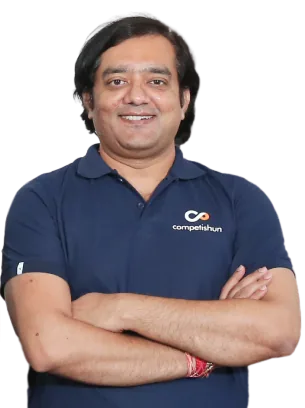
Mohit Tyagi Sir, popularly known as MT Sir, is a B.Tech from IIT Delhi with 25 years of teaching experience. His YouTube channel is followed by more than 2.2 million students and is known for deep concept clarity in Mathematics and direct, honest exam guidance. In this session, he presents the UTS test series for the JEE Main 2027 January attempt and explains how to use full mocks, special tests, performance analysis and projected percentile in the final phase of preparation.
Watch: UTS for JEE Main 2027 January Attempt
Watch Mohit Tyagi Sir explain how to use the UTS test series in the January attempt phase, from attempting a full mock to reading its analysis and projected percentile.

Video: Mohit Tyagi Sir on YouTube