When Should You Start Solving PYQs for JEE Main 2027?
JEE Main PYQs · Competishun
When Should You Start Solving PYQs for JEE Main 2027?
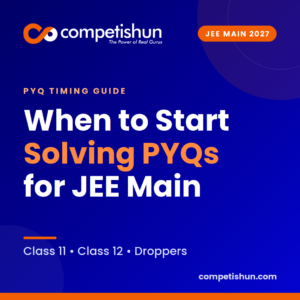
Start PYQs with each chapter, as soon as you learn it. If you are in Class 11, that means starting now, chapter by chapter, not after the syllabus ends. If you are in Class 12 or a dropper and have not started yet, start now, in the same chapter-wise way, working the unique questions first. The 2019 to 2026 pool holds 12,018 questions but only 4,348 unique patterns; the other 7,670 are repeats. So the question is not only when you start, it is what you solve first: the unique patterns, ranked by Repeat Frequency, with repeats kept inside clusters for speed practice.
Every JEE Main aspirant hears the same advice sooner or later: solve previous year questions. Almost nobody tells you when to start, and that missing detail quietly decides whether PYQs help you or hurt you. Start them before you know a chapter and they turn into guessing. Start them only in the final months and they turn into a panic revision exercise. Start them at the right time and they do the job they are meant to do: turn fresh theory into exam skill, chapter by chapter.
This guide answers the timing question properly, for each stage you might be at: Class 11, Class 12, and dropper. It uses the full 2019 to 2026 classification of JEE Main Paper 1 questions, so the advice rests on what the exam actually repeats, not on coaching folklore. You will find the short answer first, then the data behind it, then a stage-by-stage plan, then the first four weeks laid out step by step, and finally the timing mistakes that waste this resource.
One idea runs through the whole guide, so let us state it plainly at the start. PYQs are not a separate phase that comes after learning. They are part of learning each chapter. The students who gain most from PYQs are not the ones who solve the most questions. They are the ones who solve the right questions at the right time: the unique patterns first, while the chapter is still fresh.
In this guide
When Should You Start Solving PYQs? The Short Answer
The short answer depends on where you are, but the principle never changes. Start solving PYQs for a chapter as soon as you have learned that chapter properly: theory done, formulas clear, textbook examples solved. That is the moment a PYQ stops being a guess and starts being training. Everything else in this guide is that principle applied to your stage.
- Class 11: start now, chapter by chapter. Every chapter you finish in Class 11 gets its PYQs the same week. By the time Class 12 starts, you already own a large part of the pattern bank.
- Class 12: start now, and do not wait for the syllabus to end. Work chapters in the order you learn them, and use the unique-first method so limited weeks land on unseen patterns, not on repeats.
- Dropper: start from day one, unique first. Your year is short, so every week must buy pattern coverage, not volume. The unique bank, worked chapter by chapter, is the fastest route to that coverage.
If you take only one sentence from this guide, take this one. Do not ask "when should I start PYQs" as if it were one decision. Ask it chapter by chapter, every week: this chapter is learned, so its PYQs start now. That habit, repeated across the syllabus, is what a strong PYQ practice actually looks like.
Why PYQ Timing Matters: 12,018 Questions, Only 4,348 Unique
Swipe to see all four numbers
Between 2019 and 2026, JEE Main Paper 1 was held across many shifts, and the total question pool grew to 12,018. When every question is compared with every other, a clear structure appears: 4,348 questions are genuinely distinct patterns, and 7,670 are repeats: the same concept, the same model, often the same solution path with new numbers, a new diagram or a new story.
| Subject | Total PYQs (2019 to 2026) | Unique | Repeats | Unique Share |
|---|---|---|---|---|
| Physics | 4,369 | 1,527 | 2,842 | 35% |
| Chemistry | 3,781 | 1,242 | 2,539 | 33% |
| Mathematics | 3,868 | 1,579 | 2,289 | 41% |
| Total (PCM) | 12,018 | 4,348 | 7,670 | 36% |
| Counts from the full classification of JEE Main Paper 1 questions, 2019 to 2026, all shifts. | ||||
Swipe the table sideways to see all columns
Unique share by subject, from the full 2019 to 2026 classification. Chemistry repeats the most; Mathematics varies the most.
This structure is exactly why timing matters so much. Because only about 36 percent of the pool is unique, a student who starts late and rushes through PYQs in year order spends most of the remaining weeks re-solving patterns they already know, while the unseen patterns stay unseen. A student who starts early, chapter by chapter, meets the unique patterns gradually, while there is still time to fix the chapters the errors expose.
One chapter proves the point in miniature. Electrostatics contains about 223 raw PYQs in the 2019 to 2026 pool. Classified properly, they compress to roughly 80 unique patterns. A student who masters those 80 patterns and recognises them on sight has effectively prepared for 223 questions. That compression ratio, about 2.8 to 1, is typical of the heavy Physics chapters, and it is the reason the unique-first order matters: the patterns span the whole pool, and the only way to meet them all is to work through them steadily, chapter by chapter, starting early.
Class 11 Students: Start PYQs With the First Chapter, Not After the Syllabus
If you are in Class 11, you are in the best position of all, and it is easy to waste it. The temptation is to say that PYQs are for later, after the syllabus is done, after Class 12, after revision begins. That delay is the single most common PYQ regret among seniors: they reach Class 12 with theory in their notebooks and almost no exam patterns in their heads, and then they try to build two years of pattern recognition in a few months.
The better plan is simple and unglamorous. Every week, when a chapter is taught and learned, solve its PYQs before moving on. Not all 12,018 questions, and not even that chapter full bank in one sitting. The chapter unique questions first, starting with the most repeated patterns, then the repeat clusters of anything you missed or found slow. That is one focused session per chapter, and it pays off three times: the chapter gets locked in while it is fresh, your error log starts growing early, and by the end of Class 11 you already recognise a large share of the patterns the exam repeats.
- Learn, then solve, the same week: theory, formulas and textbook examples first, then the chapter PYQ set. PYQs before this step measure ignorance, not skill.
- Unique first, always: solve the chapter distinct patterns before touching repeats. Repeats become timed practice, not the main event.
- Log every error: wrong questions go into an error log with a revisit date. That log becomes your Class 12 revision bank without any extra work.
- Do not chase volume: finishing a chapter unique set properly beats half-solving three chapters. Coverage of patterns matters, not page count.
A practical note for Class 11 students who feel behind already. Starting now does not mean starting everything at once. It means starting the chapter you are on this week. The syllabus is long, but the method is weekly: one chapter learned, one chapter PYQ set solved, one error log updated. Twelve months of that habit covers more patterns than a frantic final-phase sweep ever will, because the patterns get time to settle between the first pass and the revision pass.
Class 12 Students: Start PYQs Now, Chapter by Chapter
If you are in Class 12 and have not started PYQs properly yet, the honest answer is: start now, and do not wait for a cleaner moment. There is no point in the year when the syllabus will suddenly feel finished enough to begin. Class 12 syllabus keeps arriving, revision keeps competing for hours, and the students who wait for the perfect window usually end up starting in the final months, when every error is expensive because there is no week left to fix it.
The catch-up plan has three rules. First, attach PYQs to whatever chapter you are currently learning, exactly like a Class 11 student would. Current chapters get the full treatment: learn, solve unique questions, cluster the misses. Second, for Class 11 chapters you never did PYQs for, work through their unique banks in priority order, highest Repeat Frequency first, rather than re-reading theory endlessly. Third, protect one weekly slot for the error log: re-solve last week mistakes before opening a new chapter set. Without that slot, the same errors repeat and the practice looks busy while standing still.
Class 12 students often ask whether they should finish Class 12 syllabus first and then do all PYQs together. The answer is no, for a simple reason. PYQs are how you find out whether a chapter is actually learned. A chapter you only read feels known until its PYQs prove otherwise. If you postpone that test to the end, you discover the gaps when fixing them costs the most. Test each chapter as you learn it, and the gaps stay small and fixable.
Droppers: Start PYQs From Day One, Unique First
Droppers face the sharpest version of the timing question, because the year is short and the syllabus is full. The temptation is to spend the first months only on theory, planning to start PYQs later once everything feels solid. That plan fails for the same reason every delayed PYQ plan fails, only faster: theory without PYQ testing feels complete while hiding the exact chapters that need work, and by the time the gaps surface, the calendar has no slack left in it.
For a dropper, PYQs start from day one, in lockstep with theory. Each chapter gets the same loop: learn it, solve its unique questions starting with the most repeated patterns, open the repeat clusters of anything missed or slow, take a timed chapter test, and log errors with a revisit date. Because the year is compressed, the unique-first order is not a nice idea here, it is the whole strategy. It is what lets a single year cover the pattern space of an 8-year pool: solve the 4,348 unique patterns, let the 7,670 repeats serve as timed practice and revision, and never spend a week re-solving patterns you already own.
- No theory-only months: every chapter learned gets its PYQ set the same week. Theory and PYQs move together, or the gaps hide.
- Priority order is mandatory: when weeks are scarce, work chapters and patterns in Repeat Frequency order, so limited time lands where the exam repeats most.
- Timed from the start: droppers cannot afford untimed comfort solving. Chapter tests at exam pace from the early weeks, so speed is trained, not hoped for.
- One revision cycle, protected: before the final phase, run one fast cycle over high-repeat clusters and the error log. That cycle is where patterns become permanent.
A dropper who has already attempted JEE Main once has one advantage worth using: the previous attempt showed which chapters broke under exam pressure. Start the unique bank there, not at the syllabus beginning. The chapters that cost marks last time are the chapters whose unique patterns deserve the first weeks. Everything else follows in priority order, and the error log from the previous attempt, if you kept one, becomes the first revision material of the new year.
Starting PYQs Too Early vs Too Late: Both Waste Questions
Timing mistakes come in both directions, and both waste the same precious resource: questions you can only meet fresh once. Solve a PYQ before learning its chapter and you burn it on guessing; the question is spent, the pattern is not learned, and when you meet the pattern again you feel a false familiarity without the skill behind it. Solve PYQs only at the very end and you burn the calendar instead: the patterns surface, but there is no week left to practise them properly or to fix what they expose.
| Timing | What goes wrong | What to do instead |
|---|---|---|
| Too early: before learning the chapter | Guessing, not solving. The best questions get burned on a version of you that could not have solved them. | Learn the chapter first, then solve its PYQs the same week. |
| Right time: right after learning the chapter | Fresh theory turns into exam skill. Weak spots show up chapter by chapter, while they are still fixable. | Solve the chapter unique questions first, highest Repeat Frequency first. |
| Too late: only in the final months | PYQs become a revision panic, not a skill builder. There is no time left to fix the chapters the errors expose. | If you are late, work the unique bank chapter by chapter, highest RF first, and keep full papers for the final phase. |
| Never: only full papers, no PYQ sets | A paper score tells you your score, not your problem. Chapter gaps stay hidden until the exam finds them. | Mix both: chapter-wise PYQs while learning, full papers to test stamina later. |
| Timing is about the chapter, not the calendar. The right moment per chapter is the week you learn it. | ||
Swipe the table sideways to see all columns
There is one more timing error that looks like diligence: solving PYQs as a daily volume target, disconnected from chapters. A fixed daily count, chased across random chapters, produces solved questions without building chapter skill. The chapter loop exists to prevent exactly that: learn, solve unique questions, cluster the misses, timed test, log errors. When the loop is followed, the number of questions solved takes care of itself, because each chapter contributes its unique set and nothing else. When the loop is skipped, volume becomes the goal, and volume without pattern coverage is the most expensive way to feel busy.
How to Start Solving PYQs: The First 4 Weeks, Step by Step
Advice about timing is useless without a starting procedure, so here is one. It assumes you are starting from wherever you are today, with the chapter you are currently learning. It uses UPO, Unique PYQs Only as the working example, because its structure matches the method exactly: similar questions grouped into clusters, one representative question per cluster, repeats staying inside their clusters, and every cluster ranked by Repeat Frequency. If you practise from a book or PDF instead, apply the same order manually: mark repeated questions as you meet them, and never solve a repeat before its unique parent.
The first-four-weeks starter plan
Pick the current chapter
Take the chapter you are learning this week. Open its unique PYQ set, not a full paper and not a random mixed set.
Solve unique first, highest RF first
Work the chapter distinct patterns, starting with the most repeated ones. Note the error type for every miss: concept, calculation, or reading.
The core stepCluster the misses the same day
For every unique question you missed or found slow, solve its repeats immediately. This is where a pattern becomes permanent.
Where marks are madeTimed chapter test, then log
A mixed set from the chapter at exam pace. Wrong questions go into the error log with a revisit date, one week and one month out.
Repeat that loop for four weeks, one chapter at a time, and two things will have changed. First, you will own a small set of patterns properly, instead of having glanced at a large set. Second, you will have an error log that tells you the truth about your preparation: which chapters are solid, which are shaky, and which error type keeps recurring. That log, not any solved count, is the real measure of a good start. After four weeks, the loop simply continues: next chapter, same order, same log, with one weekly slot kept for revisiting last week errors before they harden into habits.
UPO for JEE Main 2027
2019 to 2026 · Physics, Chemistry & Maths
All 12,018 JEE Main PYQs analysed and clustered: solve the 4,348 unique questions first, ranked by Repeat Frequency, with every repeat one tap away in its cluster and written, express and detailed solutions for each question.
PYQ Express
Video + Text Solutions · Chapter & Topic-wise
JEE Main PYQs sorted chapter-wise and topic-wise, with express video solutions for fast methods, detailed video solutions and step-by-step text solutions.
Two clarifications matter before you begin. First, repeats are not deleted in this system. Nothing is removed: every repeated version stays inside its cluster, labelled CL1, CL2 and so on, for speed practice and revision whenever you want it. Second, this does not replace full-paper practice. Papers train stamina, section order and time allocation, and they matter enormously in the final phase. The sequence is the point: chapter-wise PYQs while completing the syllabus, full papers later to test it under exam conditions.
PYQ Timing Mistakes That Waste Your Best Resource
- Solving PYQs before learning the chapter: turns practice into guessing and burns the best questions on a version of you that could not have solved them.
- Waiting for the syllabus to end: compresses all pattern learning into the final months, when every discovered gap is expensive to fix.
- Solving in year order only: hides repeats and never shows which patterns you have covered. Work by pattern and chapter, not by year.
- Chasing a daily question count: volume across random chapters builds solved counts, not chapter skill. The chapter loop matters more than any count.
- Reading solutions instead of solving: recognition feels like mastery until the exam changes the numbers. Every PYQ gets an honest timed attempt first.
- No error log: the questions you got wrong are the highest-value pages of your entire preparation, and most students throw them away after checking the answer.
- Skipping clusters entirely: repeats are your speed training. A pattern you never timed is a pattern you do not own yet.
- Treating all chapters as equal: chapter banks differ greatly in size and repetition. Priority order exists so that limited weeks land where the questions actually are.
If your PYQ practice so far contains one of these mistakes, the fix is not to start over. It is to change the order from today: current chapter first, unique questions first, clusters for the misses, timed test, error log. The questions you already solved are not wasted; they taught you paper style and many high-repeat patterns. What changes now is what you solve next, and in which order. That single change, applied weekly, is the difference between a PYQ collection and a PYQ method.
So, when should you start solving PYQs for JEE Main 2027? The honest answer is the one this whole guide has been building toward. If you are in Class 11, start with the chapter you are on this week. If you are in Class 12, start now, chapter by chapter, without waiting for the syllabus to end. If you are a dropper, start from day one, unique first. In every case, the start is not a date on a calendar. It is a habit: learn a chapter, solve its unique patterns, cluster the misses, log the errors, and repeat. Start that habit this week, and the 4,348 patterns will take care of themselves, one chapter at a time. Explore the method on the UPO page, and pair it with the strategy and attempt guides linked below.
Start PYQs the Unique-First Way
Solve the 4,348 unique JEE Main PYQs first, ranked by Repeat Frequency, with every repeat inside its cluster and written, express and detailed solutions on the same screen.
About Competishun
Competishun is an online JEE and NEET coaching platform with programs for Class 11, Class 12 and droppers, PYQ courses and books, study material and an All India Test Series, taught by experienced senior faculty. More than 2.2 million students follow the Competishun YouTube channel for free concept lectures and PYQ solutions.
Start PYQs at the Right Time for JEE Main 2027
Follow Competishun for daily PYQ solutions, concept lectures and JEE Main 2027 updates.
Read These Next
Your PYQ plan, shaped by syllabus finished and time left, with unique questions at the centre.
How to walk into Paper 1, what order to attempt in, and which traps to watch for on exam day.
Frequently Asked Questions
Tags